
On this page
Do you need an electrical certificate to sell a house?What is the difference between an EICR and an Electrical Installation Certificate?What does the property information form ask about electrics?Which electrical work needs a certificate under Part P?What can you do if an electrical certificate is missing?Do landlords need an EICR when selling a rented property?When should you get an EICR before selling?How can I arrange an EICR?FAQs about electrical certificates when selling a houseSources
Checks Sorted does not carry out EICRs itself. We match your enquiry with a participating independent professional, where we can.
Key facts
- An EICR is not a legal requirement for a sale in England and Wales, says the Law Society.
- Electrical installation work since 1 January 2005 must follow building regulations, so buyers may ask for certificates.
- Most electrical work needs a completion certificate, a Building Regulations Compliance Certificate or an Electrical Installation Certificate.
- GOV.UK lists an EICR as paperwork you may already have.
- A rented home needs an EICR at least every 5 years.

Do you need an electrical certificate to sell a house?
No, you do not need an electrical certificate to sell a house in England or Wales, but a buyer may ask for one for past electrical work. The Law Society says an EICR is not a legal requirement for the sale of property there. GOV.UK lists electrical checks and building regulation completion certificates among the other paperwork you may already have.
Do you need an electrical certificate to sell a house in England?
You do not need an EICR to sell a house in England, says the Law Society, but you may need to show certificates for past electrical work. Most electrical installation work needs one of these:
- A building control completion certificate.
- The installer’s Building Regulations Compliance Certificate.
- A BS 7671 Electrical Installation Certificate.
If you have one, the Society says to answer yes on the TA6 form and attach it.
Do you need an electrical certificate to sell a house in Scotland?
Not as a separate document, according to mygov.scot, which lists no electrical certificate among the parts of the Scottish Home Report. The report has a single survey and valuation, a property questionnaire and an energy report. The survey is a visual inspection by a chartered surveyor. Ask your solicitor which electrical paperwork a Scottish buyer will expect.
Do you need an electrical certificate to sell a house in Wales and Northern Ireland?
Not in Wales, where the same rule as England applies, because the Law Society covers England and Wales together. Building regulations have differed between the two since 31 July 2014, and the Welsh Government publishes its own Approved Document P. In Northern Ireland, no official page read lists an electrical certificate as a requirement for a sale, so ask your solicitor. The EPC rules for Northern Ireland are in whether you need an EPC to sell a house.
What is the difference between an EICR and an Electrical Installation Certificate?
An EICR reports on the condition of an existing installation, while an Electrical Installation Certificate records new installation work. The Law Society says an EICR assesses the safety and condition of the electrical installations in a property. NICEIC describes it as a report listing any faults and their classification codes.
| Document | What it shows | Source |
|---|---|---|
| EICR | The safety and condition of the installation, with a code for each fault | Law Society and NICEIC |
| Electrical Installation Certificate | New installation work that meets BS 7671 | Law Society |
| Building Regulations Compliance Certificate | Notifiable work signed off by the installer’s competent person scheme | Law Society and GOV.UK |
| Building control completion certificate | Notifiable work signed off by the building control body | Law Society and GOV.UK |
Our guide on what an EICR is explains the report in full, and the sections below cover the other certificates.
What is a Minor Electrical Installation Works Certificate?
A Minor Electrical Installation Works Certificate records smaller electrical work. The Scottish Government says that when an EICR recommends remedial action, any work done must be recorded separately, for example on this certificate. The EICR itself does not record the work.
What does the property information form ask about electrics?
The TA6 property information form asks sellers about electrical installation work and certificates, says the Law Society. In the 6th edition, the electrical questions are:
- Electrical work and certificates (questions 11.1 and 11.2): whether electrical installation work was done and whether you hold a certificate for it.
- The EICR (question 11.3): whether the property has a current report, which matters most for let properties.
- Solar power systems (question 5.6): whether the system is owned or leased, when it was installed and the details of any agreements.
- Electric vehicle charging points (question 10.3): what charging facilities are available at the property.
GOV.UK describes the TA6 as the form that sets out information about the property for sale, and the TA7 as its leasehold version.
How do you answer if a previous owner carried out the work?
Answer from what you know and attach any certificates you hold. The Law Society says that if you are aware of an electrical installation at the property, you may have one of the certificates. It also says to speak to your solicitor if you are not sure what information to give. No official page read gives set wording for work done by a previous owner.
Which electrical work needs a certificate under Part P?
Notifiable electrical work needs a certificate under Part P of the Building Regulations. In England, Approved Document P defines notifiable work in regulation 12(6A). The Law Society says electrical installation work has had to follow building regulations since 1 January 2005.
What counts as notifiable electrical work?
Three kinds of work count as notifiable in England, says Approved Document P:
- A new circuit: the installation of a new circuit.
- A consumer unit: the replacement of a consumer unit.
- A special location: any addition or alteration to existing circuits in a special location, such as the space around a bath or shower.
Does electrical work done before 2005 need a certificate?
Not under Part P, because the Law Society says all electrical installation work had to follow building regulations from 1 January 2005. No official page read gives a certificate rule for earlier work, so ask your solicitor how a buyer will treat it.
What is a Building Regulations compliance certificate for electrical work?
A Building Regulations Compliance Certificate is the installer’s proof that notifiable work meets the regulations. Approved Document P says an installer registered with a competent person scheme can self-certify the work. Otherwise a registered third party or a building control body certifies it, and the building control body issues a completion certificate.
What can you do if an electrical certificate is missing?
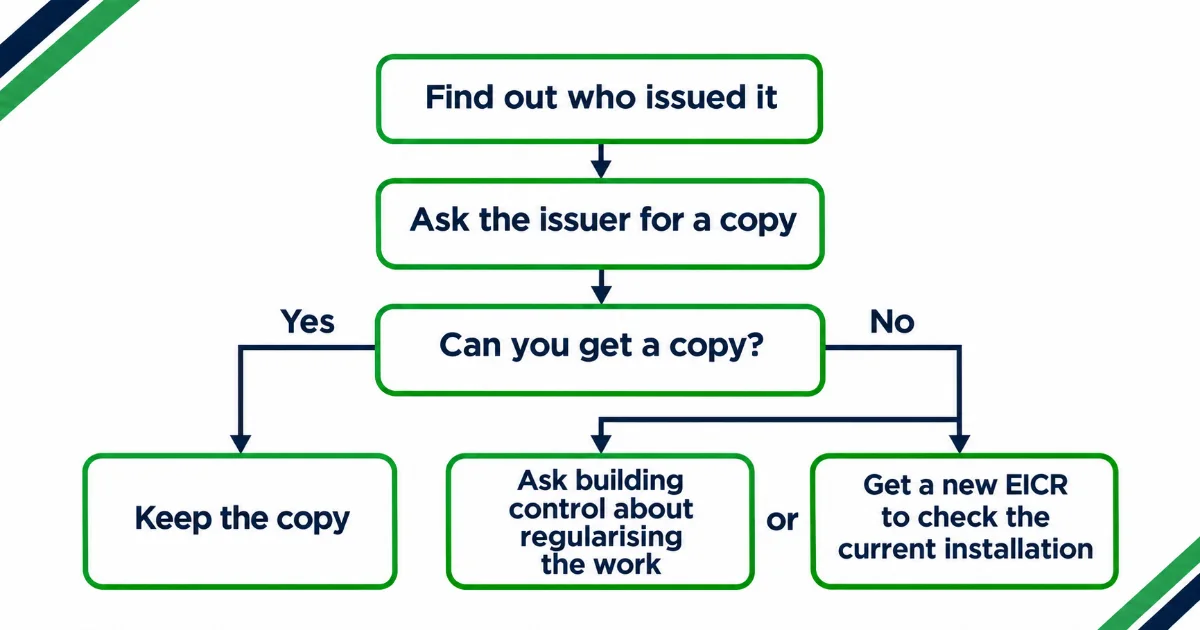
If a certificate is missing, find out who issued it and ask them for a copy. The Law Society names a building control completion certificate and the installer’s Building Regulations Compliance Certificate as two of the documents. If the work was never certified, the options below apply.
Can you get a copy of a lost certificate?
Ask the installer or the local authority building control team that holds the record. Approved Document P says notifiable work is certified by an installer’s competent person scheme, a registered third party or a building control body, so one of them should hold the record. No official page read describes a single lookup service.
Can the electrician or building control certify the work afterwards?
In England you can ask the local authority to regularise unauthorised work under regulation 18 of the Building Regulations 2010. You send a description of the work and a plan, and the authority may ask you to open up the work and carry out tests. It then says what work, if any, is needed to meet the rules that applied when the work was done. No official page read says an electrician can certify past work on their own, so ask the building control team first.
Can a new EICR replace missing paperwork for past electrical work?
No, a new EICR reports the condition of the installation as it is now and does not replace a certificate for past work. The Law Society lists the EICR separately from the three certificates for installation work. A new EICR can still show a buyer the condition of the electrics.
Do landlords need an EICR when selling a rented property?
Yes, if the home is let when you sell it. The Law Society says a buyer will want to check that there is a current EICR and that it has been supplied to the tenant. A landlord must obtain a current EICR when letting, and it must be renewed at least once every five years. The renewal period is five years in each nation:
- England: at least every 5 years, says GOV.UK.
- Wales: valid for 5 years, or the shorter time the report states, under regulation 6.
- Scotland: every five years, says the Scottish Government.
- Northern Ireland: at least every 5 years, says the Department for Communities.
When should you get an EICR before selling?
Get an EICR before you market the home if you want to show buyers the condition of the electrics, because an EICR is not required to sell in England or Wales. GOV.UK says that when you get your home sale ready you might consider having an EICR carried out.
What happens if the report comes back unsatisfactory?
If any fault has a C1 or C2 code, remedial work is required and the report states that the installation is unsatisfactory for continued use, says GOV.UK. The codes work like this:
- C1: danger present, and NICEIC says immediate remedial action is necessary. The report is unsatisfactory.
- C2: potentially dangerous, and NICEIC says urgent remedial work is necessary. The report is unsatisfactory.
- C3: improvement recommended. GOV.UK says further remedial work is not required for the report to be deemed satisfactory.
- FI: further investigation is required without delay, but GOV.UK says the installation should be safe for continued use.
The report lists each fault, its code and how to fix it.
How can I arrange an EICR?
If you want an EICR before you sell, send Checks Sorted one enquiry and we match it with a participating independent professional in your area, where we can. We do not carry out inspections ourselves. It takes four steps:
- Choose the service
Select the EICR from the list. - Share your postcode
Enter the property postcode and a few details about the home. - See your match
Checks Sorted finds a participating professional for the service and the area. - Confirm the details
The professional contacts you to confirm the day, the work and the price.
FAQs about electrical certificates when selling a house
Is an EICR a legal requirement to sell a house?
No, not when you sell in England or Wales. A landlord must hold a current EICR when letting, and the Law Society says it must be renewed at least once every five years. Our guide on whether an EICR is a legal requirement covers the rules for each nation.
How long is an EICR valid for when selling a house?
There is no set validity for a sale, because no EICR is required and no official page sets how recent it must be. The report itself states the date of the next inspection, says GOV.UK. Our guide on how long an EICR lasts explains the dates.
How much does an EICR cost before selling a house?
There is no fixed price, because NICEIC says the cost varies with the size of the property, the complexity of its electrical systems and what the inspector charges. Our EICR cost guide shows how to compare quotes for your own home.
Do I need an EPC as well as an electrical certificate?
Yes, in most cases a house sale also needs an EPC, which is a separate certificate from electrical paperwork, says GOV.UK. The rules, timing and exemptions differ by nation.
Sources
- Law Society: TA6 Property information form (6th edition), explanatory notes
- GOV.UK: How to sell a home
- GOV.UK: Electrical safety, Approved Document P
- Welsh Government: Approved Document P, electrical safety in dwellings
- legislation.gov.uk: The Building Regulations 2010, regulation 18
- GOV.UK: Find an energy certificate
- mygov.scot: Home Report
- nidirect: Energy Performance Certificates
- NICEIC: Electrical Installation Condition Reports
- GOV.UK: Electrical safety standards in the private and social rented sectors, guidance
- legislation.gov.uk: Renting Homes (Fitness for Human Habitation) (Wales) Regulations 2022, regulation 6
- Scottish Government: Repairing Standard statutory guidance for private landlords
- Department for Communities: Electrical safety standards in private tenancies, Northern Ireland