
On this page
When do you need an EPC to sell a house?Is an EPC a legal requirement when selling a house?Can you use an EPC you already have to sell a house?Can you sell a house with a low EPC rating?Can you sell a house without an EPC?Do you need an EPC to sell a house in Scotland, Wales and Northern Ireland?How do you get an EPC to sell a house?How can I arrange an EPC?FAQs about selling a house with an EPCSources
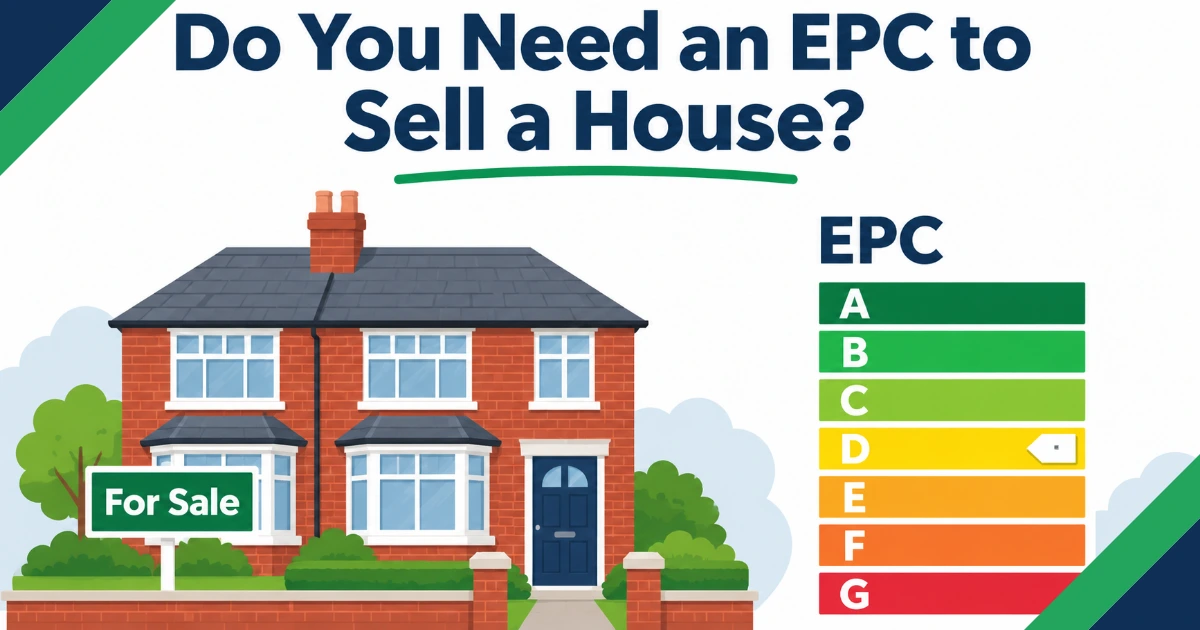
An EPC, also called an energy certificate, rates a property’s energy efficiency from A (best) to G (worst) and lists recommended ways to improve it.
Checks Sorted does not carry out EPC assessments or issue certificates itself. We match your enquiry with a participating independent professional, where we can.
Key facts
- Yes, you need an EPC to sell a house in all four UK nations, unless an exemption applies, such as some listed buildings.
- In England and Wales you must order it before you market the property, under regulation 7, and GOV.UK says the same.
- The seller pays for the EPC, and prospective buyers must be given it free of charge.
- An EPC is valid for 10 years, so you can reuse a valid one for the sale.
- Selling without one can bring a £200 penalty for a dwelling in England and Wales, enforced by Trading Standards.
- Scotland and Northern Ireland have their own rules. In Scotland the EPC is part of the Home Report, and Northern Ireland needs one before a home is marketed.
When do you need an EPC to sell a house?
In England and Wales you need an EPC before the house is put on the market. Regulation 7(2) says “Before the building is put on the market, the relevant person must secure that an energy performance certificate is commissioned for the building”, and for a sale the relevant person is the seller. GOV.UK puts it plainly: “You must order an EPC for potential buyers and tenants before you market your property to sell or rent.”
Can you list your house while you wait for the EPC?
Yes, once the EPC has been commissioned. Commissioned means you have asked an accredited energy assessor to produce it and paid, or agreed to pay, for it. Regulation 7 then sets the timing:
- Order the EPC before the house goes on the market.
- Use all reasonable efforts to have a valid EPC within 7 days of the house first being marketed.
- If that is not possible, you have up to 21 more days, so about 28 days at most from the start of marketing.
An estate agent must also be satisfied that an EPC has been commissioned before they market the house.
When must you give the EPC to a buyer?
At the earliest opportunity, and no later than the first written information you give a prospective buyer or a viewing, whichever comes first. Under regulation 6(2) you must make a valid EPC available to them free of charge. A person counts as a prospective buyer once they ask for information, ask to view or make an offer. The person who ends up buying must be given a valid EPC free of charge too.
You must also show the EPC rating, from A to G, in any advert for the sale in commercial media, under regulation 11. The full certificate does not have to appear in the advert.
Do you need an EPC to sell a house privately?
Yes. The duty falls on the seller, whether or not an estate agent is used. The regulations place it on the seller, who is the “relevant person”, so a private seller follows the same steps as one who uses an agent.
Is an EPC a legal requirement when selling a house?
Yes, unless the house is exempt. In England and Wales the Energy Performance of Buildings (England and Wales) Regulations 2012 put the duty on the seller, and the penalty for a dwelling is £200. Scotland and Northern Ireland have their own regulations with the same aim, covered under the nations section below. Our guide to why you need an EPC explains what buyers and tenants use it for.
Can you use an EPC you already have to sell a house?
Yes, if the EPC is still valid. GOV.UK says an EPC is valid for 10 years. The GOV.UK guide for dwellings adds that it is valid “for 10 years or until a newer EPC is produced for the same building no matter how many times the property is sold or rented out during that period”. Only the most recent EPC for a building is valid.
How can you check if your house already has a valid EPC?
Search the EPC register on the find an energy certificate service, using the steps in how to check your EPC rating if you want them in order. You can search by postcode, street name and town, or certificate number. It covers England, Wales and Northern Ireland, and Scotland has its own register.
Do you need a new EPC if yours has expired?
Yes. GOV.UK says “If your property does not have an EPC or it has expired, you’ll need a new one before you get your property ready to sell or rent.” Order the new one from an accredited assessor before you list the house.
Can you improve your EPC rating before you sell?
Yes, but you do not have to. Your EPC lists recommended ways to improve the rating, and the dwellings guide says “There is no statutory requirement to carry out any of the recommended energy efficiency measures stated.” Whether the work is worth doing before you sell is your choice, and the steps for raising a rating are in how to improve the EPC rating of your home.
Do you need a new EPC after improving the house?
We found no official rule that makes you commission a new EPC just because you have made improvements. If you do have a new assessment lodged, only the most recent EPC counts.
Can you sell a house with a low EPC rating?
Yes, as far as the official guidance shows. We found no minimum EPC rating for selling a house, and the official selling pages ask for an EPC, not for a particular band. An EPC gives a property an energy efficiency rating from A (best) to G (worst), and buyers see that rating in the advert and on the certificate, while the score behind each band is explained in how EPC ratings are calculated.
Does a low EPC rating matter to buyers who want to let the house?
It can. The minimum energy efficiency standard (MEES) is a rule for lettings, not sales. The two points to know are:
- GOV.UK landlord guidance says landlords cannot let a property with an EPC rating below E without a valid exemption.
- The government response says private landlords of all tenancies will be required to meet a higher standard by 1 October 2030, subject to Parliamentary approval.
So a buyer who plans to let the house may want to check the rating first.
Can you sell a house without an EPC?
Only if the house is exempt. The dwellings guide says there are no other exemptions from the EPC obligations, although some transactions do not count as a sale or renting out, so check when an EPC is not required for the full list of exempt buildings.
Do listed buildings and conservation area homes need an EPC?
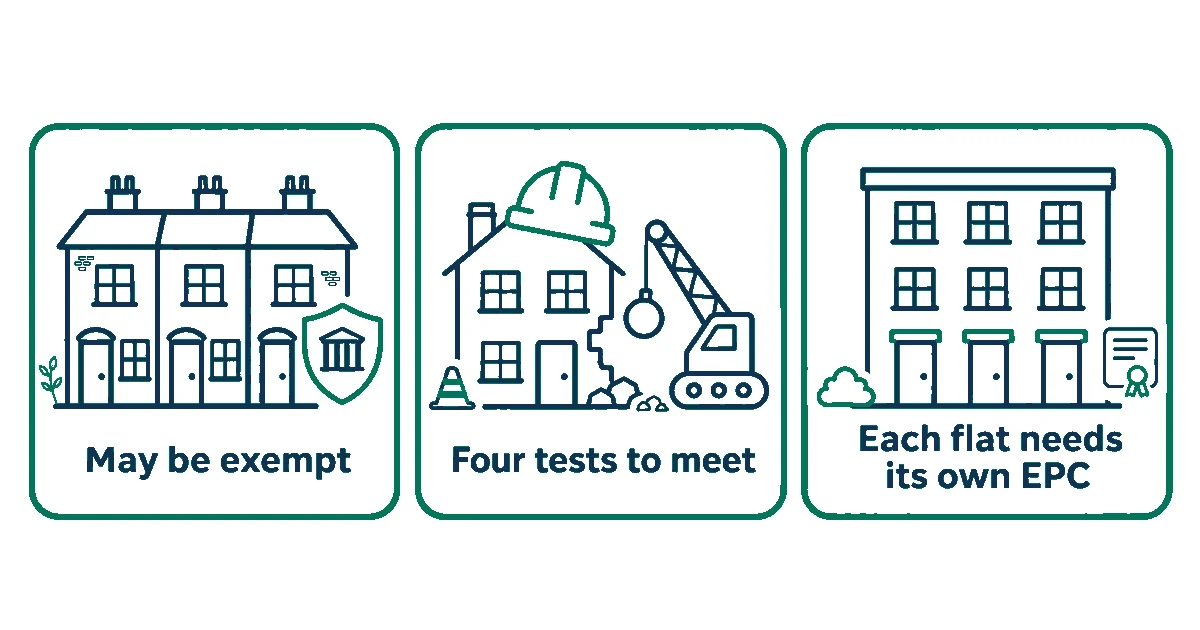
They may be exempt, but not automatically. Regulation 5 exempts buildings officially protected “as part of a designated environment or because of their special architectural or historical merit”, but only “in so far as compliance with certain minimum energy performance requirements would unacceptably alter their character or appearance”. The dwellings guide gives listed buildings and buildings in a conservation area as examples and says owners “will need to take a view”. It suggests asking the local authority conservation officer.
Can you sell a house for demolition without an EPC?
Sometimes, but the test is strict for a house. Under regulation 8 the seller must be able to show all four of these:
- The dwelling is suitable for demolition.
- The resulting site is suitable for redevelopment.
- All the demolition consents exist.
- Planning permission exists for the redevelopment.
A buyer saying they plan to knock it down is not enough for a dwelling.
Do new builds, flats and leasehold homes need an EPC?
Flats and leasehold homes need one, and so does a new build once construction is complete. The specific rules are:
- A new build does not need an EPC for a buyer before construction is complete, says regulation 5(2).
- A flat that is designed to be used separately counts as a “building unit”, so each flat that is sold needs its own EPC.
- Selling a lease counts too, as the dwellings guide says existing occupiers need an EPC if they “sell, assign or sublet” their interest.
- Lease renewals, extensions and surrenders are not sales.
Do you need an EPC to sell a house at auction?
We found no auction exemption in the official guidance. The regulations apply to any building that is to be sold and do not limit the method of sale, so plan to have the EPC ready before the house is advertised for auction.
What is the penalty for selling a house without an EPC?
The penalty for a dwelling in England and Wales is £200, set by regulation 38. The main points are:
- Every local weights and measures authority, which means Trading Standards, enforces it.
- A notice cannot be given more than six months after the breach.
- You have at least 28 days to pay or ask for a review.
- Failing to state the rating in an advert carries its own £200 charge.
Do you need an EPC to sell a house in Scotland, Wales and Northern Ireland?
Yes in all three, but the rules sit in different places. England and Wales share one set of regulations, and Scotland and Northern Ireland each have their own.
| Rule | England and Wales | Scotland | Northern Ireland |
|---|---|---|---|
| When you need it | Before the house goes on the market | When a building is to be sold, as part of the Home Report | Before a building is marketed for sale or rent |
| Who gives it to buyers | The seller, free of charge | Given to the purchaser free of charge | The owner, at no cost to the buyer |
| How long it lasts | 10 years, or until a newer EPC is produced | 10 years | 10 years |
| Penalty for a home | £200 | At least £500 | £200 |
| Enforced by | Trading Standards (local weights and measures authority) | The local authority | District councils |
| Where to search | GOV.UK find an energy certificate | Scottish EPC Register | GOV.UK find an energy certificate |
Do you need an EPC to sell a house in England and Wales?
Yes. Wales uses the same Energy Performance of Buildings (England and Wales) Regulations 2012 as England, so the same regulations apply in Wales. We found no separate Welsh rules for selling a home.
Do you need an EPC to sell a house in Scotland?
Yes. The Scottish Government says an EPC is required “when a building is to be sold”, and it must be provided to the purchaser, free of charge.
The EPC forms the energy report in the Home Report, which also holds the single survey and valuation and a property questionnaire. A seller or selling agent must give you the Home Report within nine days of you asking for it, says mygov.scot. If a home does not need a Home Report, the seller must still give you an EPC. The other key points for Scotland are:
- A Scottish EPC is valid for 10 years, says the Scottish Government.
- The minimum penalty is £500 for a home, issued by the local authority, according to the same guide.
- Buyers can look up a certificate on the Scottish EPC Register with the report reference number or the postcode.
Scotland is also changing its EPC rules, so check the Scottish Government reform updates before you sell.
Do you need an EPC to sell a house in Northern Ireland?
Yes. nidirect says an EPC is needed whenever a property is marketed for sale or rent, and the Department of Finance says it must be obtained before a building is marketed. Northern Ireland also has these points:
- Each EPC is valid for 10 years.
- District councils enforce the rules, and the Department of Finance says the penalty for a dwelling is £200.
- Northern Ireland certificates are on the same GOV.UK find an energy certificate service as England and Wales.

How do you get an EPC to sell a house?
You order it from an accredited assessor. Only an accredited domestic energy assessor can carry out the assessment and lodge the data on the register, and the assessor gives you a digital copy of the certificate.
Who arranges and pays for the EPC when you sell a house?
The seller does. GOV.UK says “You’ll need to pay for an EPC from an accredited assessor” and that your estate agent may be able to help arrange it. The buyer does not pay, because prospective buyers and the final buyer must receive the EPC free of charge.
How do you find an accredited assessor?
Use the GOV.UK service to get a new energy certificate, which lets you find an accredited assessor and says to check they are part of an accredited scheme. The same page says the cost of an assessment varies by assessor and the size of the property, so ask for a quote before you book.
Will the EPC rules for selling a house change?
Possibly. GOV.UK says “we have decided to move the launch of the reforms to the second half of 2027”. Until then the current A to G certificates and the rules above apply. The date may change, so check GOV.UK before you sell.
How can I arrange an EPC?
If your house needs an EPC, send Checks Sorted one enquiry and we match it with a participating independent professional in your area, where we can. We do not carry out assessments ourselves. It takes four steps:
- Say what you need
Select the property safety service you want. - Add the postcode
Enter the property postcode and any other details. - Get matched
Checks Sorted finds a participating professional for the service and the location. - Talk it through
The professional contacts you about availability, price and the work required.
FAQs about selling a house with an EPC
Do I need an EPC to sell my house?
Yes, unless your house is exempt. GOV.UK says you must have an EPC when you sell a property, and you can be fined if you do not get one when you need one. In England and Wales you must order it before you market the house.
Do you need an EPC certificate to sell a house?
Yes. The EPC certificate comes from an accredited assessor, and you can use an existing one if it is still valid.
How long does an EPC last when you sell a house?
An EPC is valid for 10 years, or until a newer EPC is produced for the same building, says the GOV.UK dwellings guide, and the rule is in regulation 9(2) of the 2012 Regulations. A valid one can be used for the sale, and if it has expired you need a new one before you get your property ready to sell. The full rules on expiry and renewal are in how long an EPC lasts.
Do you need an energy certificate to sell a house?
Yes. For a home, an energy certificate means an EPC. You can search for an existing one on the find an energy certificate service before you order a new one.
Can an estate agent market my house without an EPC?
Not unless an EPC has been commissioned. The regulations say a person acting for the seller must be satisfied that an EPC has been commissioned before the house is marketed. The seller still carries the legal duty.
Does the buyer have to pay for the EPC?
No. The seller must make a valid EPC available to prospective buyers free of charge and give one to the person who buys the house.
Do I need an electrical certificate as well as an EPC to sell a house?
No, an electrical report (EICR) is not a legal requirement for a sale in England and Wales, says the Law Society, though buyers may ask for one. An EPC is a different document, so read whether you need an electrical certificate to sell a house for the detail.
Sources
- GOV.UK: Selling a home, energy performance certificates
- GOV.UK: A guide to energy performance certificates for the marketing, sale and let of dwellings
- legislation.gov.uk: The Energy Performance of Buildings (England and Wales) Regulations 2012, regulations 2, 3, 5, 6, 7, 8, 9, 11, 34 and 38
- GOV.UK: Get a new energy certificate
- GOV.UK: Domestic private rented property, minimum energy efficiency standard, landlord guidance
- GOV.UK: Improving the energy performance of privately rented homes, government response
- GOV.UK: Reforms to the energy performance of buildings regime
- Scottish Government: Energy Performance Certificates guide, requirements and buildings for sale
- Scottish Government: Energy Performance Certificate reform updates
- mygov.scot: Home Report
- Law Society: TA6 explanatory notes
- nidirect: Energy Performance Certificates
- Department of Finance: Energy Performance Certificates frequently asked questions