
Energy Performance Certificate (EPC) and Energy Assessments
Last updated 7 November 2026
An energy performance certificate (EPC) tells you how energy efficient a property is, and most properties that are sold or let need one. GOV.UK selling guidance says you must order it from an accredited assessor before you market the property. If you need an EPC certificate near you, send Checks Sorted the postcode and tell us whether the property is a home or business premises. We pass your enquiry to participating independent professionals who cover that area. Checks Sorted does not carry out EPC assessments or issue certificates itself.
Matching depends on the service requested and the availability of participating professionals.
EPC Key Facts for Sellers, Landlords and Businesses
Rating. A (best) to G (worst), with the property's energy use, typical energy costs and steps to improve (GOV.UK selling guidance).
↗Who needs one. Sellers, landlords and builders of homes, and businesses that sell, rent out or newly build premises, subject to exemptions (GOV.UK selling guidance).
↗Rental minimum. A rented home covered by the regulations needs band E in most cases (GOV.UK landlord guidance).
↗Existing EPCs. Search the EPC register on GOV.UK to get your EPC certificate online. A valid certificate can be downloaded for free, so check the register and download your EPC before ordering a new one.
↗Cost. The EPC certificate cost varies by assessor and the size of the property. Checks Sorted does not set prices.
↗Why Use Checks Sorted for Your EPC Certificate?
Checks Sorted lets you send one EPC enquiry and passes it to a participating independent professional, who then contacts you to agree the details.
Ask about an EPC alongside an EICR, a gas safety certificate, a fire risk assessment or fire alarm servicing.
The postcode and property type help us look for a participating independent professional covering your area, subject to availability.
The scope, price and appointment are settled between you and the professional.
The legal points on this page link to GOV.UK, legislation.gov.uk or the ONS.
What Is an EPC Certificate?
An EPC certificate, or energy performance certificate, is a rating of how energy efficient a property is, from A (best) to G (worst), according to GOV.UK selling guidance. It also holds information about the property's energy use and typical energy costs, plus steps to improve its energy efficiency and save money.
The GOV.UK EPC guide to EPCs for dwellings adds that a certificate carries the address, the date it was issued, a reference number and a recommendation report.
What Does an EPC Check Involve?
An EPC check, sometimes called an EPC test, involves a physical EPC survey of the building by the assessor, according to the GOV.UK EPC guide to EPCs for dwellings, with access to all the rooms, the boiler and the loft if safe. The assessor will need to know:
Without supporting evidence such as receipts, the assessor cannot include a feature that cannot be seen, such as cavity wall insulation.
How Do You Check an EPC Certificate by Postcode on the EPC Register?
Use the find an energy certificate service on GOV.UK, the official EPC register and EPC lookup for England, Wales and Northern Ireland. You can search by postcode, street name and town, or certificate number, so it works as an EPC rating checker for any address. GOV.UK selling guidance says you can use it to check whether a property has a valid energy performance certificate and download it for free.
| What the search shows | What GOV.UK says |
|---|---|
| A valid EPC for the property | You can download it for free. |
| The property does not appear in the service | You may need a new EPC. |
| The EPC has expired, or the property never had one | You need a new one before you get the property ready to sell or rent. |
If you need help finding an energy certificate or report, GOV.UK EPC register says to contact the Ministry of Housing, Communities and Local Government (MHCLG). Scotland has a separate service, so this page covers England and Wales.
Who Needs an EPC Certificate?
You must have a residential EPC when you sell a property, rent it out or build a new one, and a commercial one when business premises are sold, rented out or newly built, according to GOV.UK selling guidance. Each type of enquiry needs slightly different details:
Home sellers. Order the EPC before you market the property.
Landlords and letting agents. Order it before you market the property to rent, and show it to prospective tenants. The person who ultimately becomes the tenant must be given a valid copy free of charge (regulation 6).
New builds. Only an accredited on construction domestic energy assessor can produce the EPC.
Businesses. A commercial EPC, or non domestic EPC, is needed when premises are sold, rented out or newly built, subject to exemptions.
EPC for Landlords: What Does a Rental Property Need?
An EPC certificate for landlords must usually show band E or better, and the same rule applies to any EPC certificate for rental property. The EPC requirements for landlords in England and Wales set two rules:
The minimum EPC rating for rental, or minimum EPC for rental, is band E in most cases. Since 1 April 2020, a property covered by the minimum energy efficiency standards cannot be let below that rating without a valid exemption (GOV.UK landlord guidance).
A landlord is not currently required to spend more than £3,500 including VAT on improvements, and local authorities enforce the rules.
What If a Rental Property Cannot Reach Band E?
The landlord can register an exemption on the PRS Exemptions Register, such as all relevant improvements made, high cost, wall insulation or third-party consent (GOV.UK landlord guidance). Most last 5 years.
When Is an EPC Not Required for Residential Property?
An EPC is not required for some listed buildings, holiday lets, temporary buildings, small stand-alone buildings and places of worship, according to GOV.UK selling guidance, which also lists residential buildings used less than 4 months a year and some buildings due to be demolished. The common energy performance certificate exemptions:
| Property | Is an EPC needed? |
|---|---|
| Individual room in a shared house | No. The whole building needs one if it is sold or rented out as a whole. |
| Listed building | Not if the work to meet minimum energy performance requirements would unacceptably alter its character or appearance. |
| Holiday let | Not if rented out for less than 4 months a year or let under a licence to occupy. |
| Temporary building under 2 years, stand-alone building under 50 square metres, place of worship | No. |
Who Can Carry Out an Energy Performance Certificate?
Only an accredited energy assessor can produce an energy performance certificate. For a domestic EPC, the GOV.UK EPC guide says only an accredited domestic energy assessor may carry out the assessment. GOV.UK new EPC guidance says to contact the assessor directly and check that they belong to an accredited scheme, and the regulations say an assessor must be a member of a scheme approved by the Secretary of State (regulation 22). An electrician is not an assessor unless they are also accredited.
EPC for New Build: What Is Required?
A new build must have an energy performance certificate (GOV.UK selling guidance), and only an accredited on construction domestic energy assessor can produce the new build EPC. The assessor works from plans, so no site visit is required (GOV.UK EPC guide).
The rating uses SAP, the Standard Assessment Procedure, which the government uses to show that new homes comply with Part L of the Building Regulations (GOV.UK SAP guidance).
What Does an EPC Rating Mean?
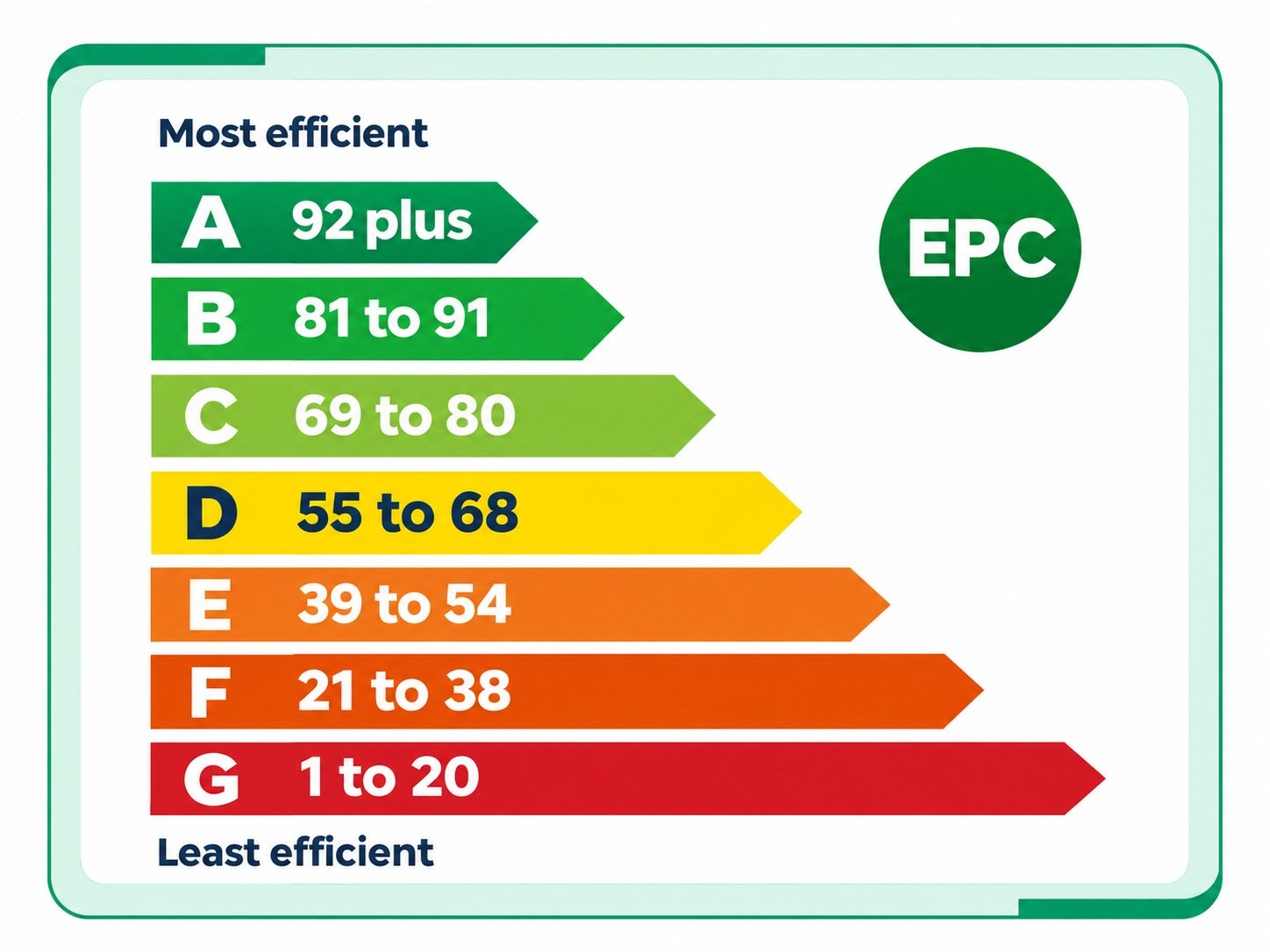
EPC ratings run from A (best) to G (worst). An EPC rating is the band shown on the energy performance certificate (GOV.UK selling guidance) and the EPC energy rating scale is made up of those bands. The ONS gives the EPC scores behind each domestic band:
| EPC band | Score |
|---|---|
| A A (most efficient) | 92 plus |
| B B | 81 to 91 |
| C C | 69 to 80 |
| D D | 55 to 68 |
| E E | 39 to 54 |
| F F | 21 to 38 |
| G G (least efficient) | 1 to 20 |
So an EPC rating D means a score of 55 to 68, an EPC rating C is 69 to 80, an EPC rating E is 39 to 54, an EPC rating F is 21 to 38, an EPC rating A is 92 plus and an EPC rating G is 1 to 20.
How Is an EPC Rating Calculated?
An EPC rating is calculated when the assessor enters the survey data into the Standard Assessment Procedure (SAP) methodology, the method the government uses to estimate the energy performance of homes (GOV.UK SAP guidance). For existing buildings marketed for sale or rent, the reduced data version, RdSAP, is generally used. The resulting score falls into one of the bands A to G shown above.
How to Improve EPC Rating
To improve your EPC rating, start with the recommendations on your EPC report. The GOV.UK EPC guide says each one lists an indicative cost, typical savings and the rating after improvement, and none is a statutory requirement. The GOV.UK energy saving service gives owners in England and Wales improvement recommendations with an estimated cost and saving.
A registered energy performance certificate cannot be altered and only the most recent EPC is valid, so a new assessment shows a new rating.
How Much Does an Energy Performance Certificate Cost?
The EPC cost varies by assessor and the size of the property, according to GOV.UK new EPC guidance. Each participating professional prices their own EPC services, and Checks Sorted does not set prices, so the cost of an EPC is agreed with the professional and no EPC price appears here. Compare each EPC quotation using these questions:
| Ask about | What to clarify |
|---|---|
| Property details | Does the quote cover the size, type and any extension you described? |
| Lodging | An EPC is only valid if generated from data lodged on the register. Is lodging included? |
| Digital copy | The assessor gives you a digital copy. How and when will you get it? |
What Are the Penalties for Not Having an EPC?

You can be fined if you do not get an energy performance certificate when you need one. GOV.UK selling guidance gives no amount for homes. The official guidance adds:
Business premises. According to GOV.UK commercial EPC guidance, a fine of £500 to £5,000 based on the rateable value if no EPC is made available to a buyer or tenant, with an appeal to the county court within 28 days of a confirmed penalty.
Rented homes below band E. A landlord who lets a covered property below band E without a valid exemption can be fined up to £5,000 per property in total, with up to £2,000 for a letting of under 3 months and £4,000 for 3 months or more, as the GOV.UK landlord guidance explains.
How to Get an EPC Certificate Quote
To get an energy performance certificate (EPC) through Checks Sorted, follow these steps.
-
1
Choose EPC and enter the postcode. Add the property type, whether it is being sold or let, and any access requirements.
-
2
We match your enquiry. We look for a participating professional who offers EPCs and covers your postcode, subject to availability.
-
3
Agree the quote and the visit. If we find a match, you settle the scope, price and timing with the professional directly.
-
4
The professional assesses and issues the EPC. They carry out the agreed assessment, issue the certificate and explain any follow-up.
The enquiry form asks for the postcode, the type of property and how it is used, so the professional has the details they need. You can add anything else they should know in the notes, such as loft access, or that you manage several properties.
Request a quoteCan I Arrange an Energy Performance Certificate Near Me?
Yes, if the property is in Reading, Slough, High Wycombe, Maidenhead or Uxbridge, where Checks Sorted is starting, subject to availability. Enter the property postcode and we will look for a participating professional covering your area, whether you are looking for an EPC near me or EPC assessors near me. This page covers England and Wales.
Other Landlord Safety Checks
Most landlords also need a gas safety certificate and an electrical inspection (EICR) for the same property. You can enquire about those, a fire risk assessment or fire alarm servicing through Checks Sorted, and say in each enquiry that the checks are for the same property.
Energy Performance Certificate FAQs
What Does EPC Stand For?
EPC stands for energy performance certificate, and that is the EPC full form. According to GOV.UK selling guidance, the EPC meaning for a house is that it rates the home from A (best) to G (worst) for energy efficiency.
How Do I Get an Energy Performance Certificate?
To get an EPC, first search the register to check whether the property already has a valid one. If it does not, send Checks Sorted your postcode and property type, and a participating independent professional covering your area contacts you. The assessor then visits and you receive a digital copy, according to GOV.UK new EPC guidance.
How Do I Book an EPC?
You book an EPC with an accredited energy assessor, and GOV.UK new EPC guidance says to contact the assessor directly and check that they belong to an accredited scheme. Through Checks Sorted, you send an EPC booking enquiry with your postcode and property type, and a participating independent professional contacts you, so the appointment is arranged with them.
How to Get an EPC Rating?
To get an EPC rating, have the property assessed by an accredited energy assessor, who gives you a digital copy of the certificate showing the rating from A (best) to G (worst), according to GOV.UK new EPC guidance.
How to Check EPC Rating?
Do an EPC check by postcode on the EPC register, or search by street name and town or certificate number (GOV.UK EPC register). The certificate shows the rating from A to G, and GOV.UK selling guidance says you can download a valid energy performance certificate for free.
How Do I Do an EPC Certificate Check Online?
Use the find an energy certificate service on GOV.UK, the official EPC register, and enter the postcode, the street name and town, or the certificate number. It shows whether the property has a valid EPC, which you can download for free, according to GOV.UK selling guidance.
What Is a Good EPC Rating?
According to GOV.UK selling guidance, an A rating is the best and G is the worst. For a rented home in England and Wales, band E is the lowest rating a landlord can generally let with, and the government response plans a band C standard from 1 October 2030, subject to Parliamentary approval.
Do You Need an EPC to Sell a House?
Yes. GOV.UK selling guidance says you must have an energy performance certificate when selling a property and must order it before you market it. The person who ultimately becomes the buyer must also be given a valid copy free of charge, as regulation 6 says.
When Do You Need an EPC?
You need an EPC when you sell, rent out or build a property, and you must order it before you market the property, according to GOV.UK selling guidance. For business premises, a commercial EPC is needed when they are sold, rented out or newly built.
Do Commercial Properties Need an EPC?
Yes. According to GOV.UK commercial EPC guidance, you must have a commercial EPC if you rent out or sell business premises, or when a building under construction is finished. From 1 April 2023, privately rented business premises in England and Wales also need at least band E, unless a valid exemption is registered, as the GOV.UK non-domestic landlord guidance explains.
Do Listed Buildings Need an EPC?
Not always. An EPC for listed buildings is not needed if the work to meet minimum energy performance requirements would unacceptably alter their character or appearance, and GOV.UK selling guidance advises checking with your local authority's conservation officer.
Does an EPC Expire During a Tenancy?
It can, because an EPC lasts 10 years, so the EPC expiry date can fall during a tenancy. Existing tenants do not need an EPC unless they sell, assign or sublet their interest, according to the GOV.UK EPC guide. For EPC renewal, a valid EPC is needed before the property is marketed again.
What Is the Landlord EPC Band C Deadline?
The landlord EPC band C deadline is 1 October 2030 for privately rented homes in England and Wales, according to the government response. These new EPC rules for landlords are subject to Parliamentary approval, and band E applies until then.
How Long Does an EPC Take?
There is no standard time for an EPC assessment, because GOV.UK new EPC guidance gives none. The seller or landlord must use all reasonable efforts to obtain a valid certificate within 7 days of marketing, and within a further 21 days if that fails (regulation 7).
How Long Does an EPC Certificate Last?
An energy performance certificate is valid for 10 years (GOV.UK selling guidance), and the same applies to business premises. It stays valid until a newer EPC is produced for the same building (GOV.UK EPC guide). When it has expired, or the property never had one, you need a new one before you get the property ready to sell or rent.
Request an Energy Performance Certificate Quote
Send the postcode and property type to get your EPC quote, say whether it is being sold, let or built, and tell us if you also need an EICR or gas safety certificate.
Request a quote