
On this page
Is an EICR a legal requirement for landlords?Which tenancies are covered in England?Do social landlords need an EICR?When did an EICR become a legal requirement?Is an EICR a legal requirement for homeowners?Is an EICR a legal requirement for commercial premises?Can an Electrical Installation Certificate replace an EICR?Can you use an existing EICR when a new tenant moves in?What happens if a landlord has no EICR?Who can carry out an EICR?How can I arrange an EICR?Is an EICR a Legal Requirement? FAQsSources
Checks Sorted does not carry out EICRs itself. We match your enquiry with a participating independent professional, where we can.
Key facts
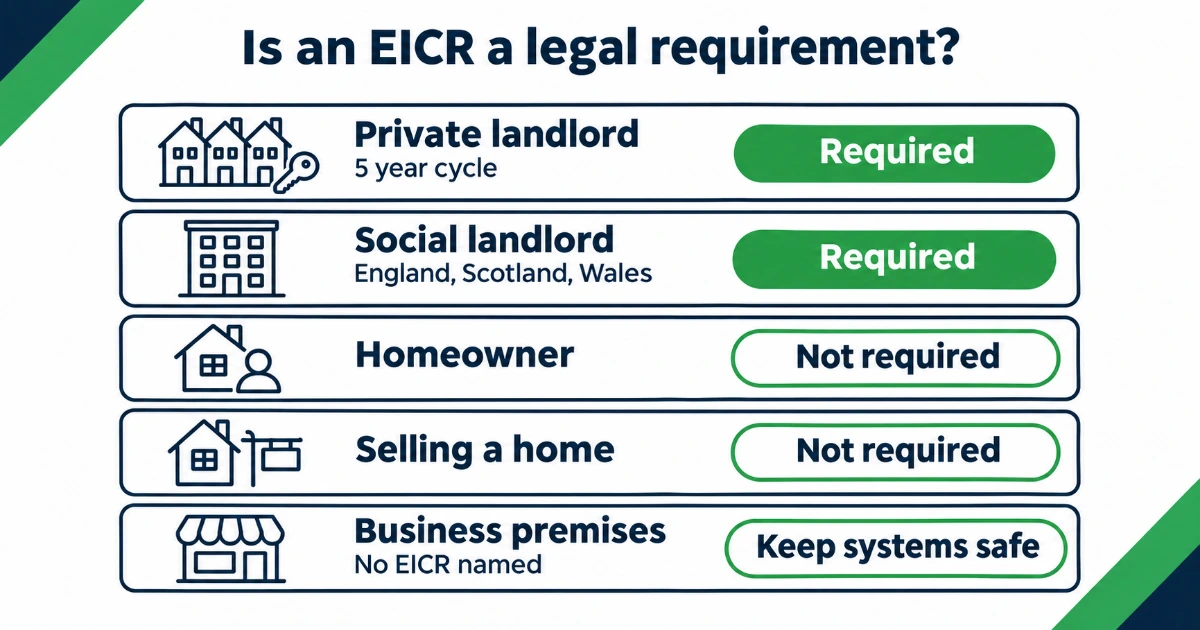
- Landlords in all four UK nations need an EICR on a 5 year cycle.
- In England the rule applies from 1 July 2020 for new tenancies and 1 April 2021 for existing ones.
- A council in England can fine a landlord up to £40,000, says GOV.UK.
- The rules for social landlords in England came into force on 1 November 2025.
- An EICR is not needed to sell a home in England or Wales, says the Law Society.
- Regulation 4 of the Electricity at Work Regulations requires systems to be maintained and does not name an EICR.
Is an EICR a legal requirement for landlords?
Yes, landlords of rented homes legally need an EICR in every UK nation. The renewal period is 5 years in each nation, although each nation has its own law:
- England: at least every 5 years, by a qualified person, says GOV.UK.
- Wales: valid for 5 years, or the shorter time the report states, under regulation 6.
- Scotland: every five years, says the Scottish Government.
- Northern Ireland: at least every 5 years, says the Department for Communities.
Which tenancies are covered in England?
Any tenancy where the tenant uses the home as their only or main residence and pays rent is covered in England, says GOV.UK. The rules apply whether or not the rent is a market rent. GOV.UK lists these exceptions:
- Shared accommodation with the landlord or the landlord’s family.
- Long leases, including shared ownership, and tenancies of 7 years or more.
- Student halls of residence.
- Care homes, hospitals and hospices.
- Mobile homes, caravans and boats.
Do social landlords need an EICR?
Yes, social landlords in England need an EICR, because regulations extended the rules to the social rented sector on 1 November 2025. GOV.UK says they apply to tenancies granted after 1 December 2025. For earlier tenancies the rules came into force on 1 May 2026, and the first inspection was required before 1 November 2026.
When did an EICR become a legal requirement?
An EICR became a legal requirement for private landlords in England on 1 July 2020 for new tenancies and 1 April 2021 for existing ones. The 2020 England regulations came into force on 1 June 2020 and apply from those two dates. The other nations started at different times:
- Northern Ireland: from 1 April 2025 for new private tenancies, with existing tenancies given until 1 December 2025, says the Department for Communities.
- Wales: from 1 December 2022, when landlords had to meet the fitness for human habitation rules, says the Welsh Government.
- Scotland: we found no official page that gives a start date for the electrical safety rule.
Is an EICR a legal requirement for homeowners?
No, homeowners who live in their own home have no landlord duty to hold an EICR. The England rules from GOV.UK cover rented homes, and no official page read sets an EICR duty on owner occupiers. HSE still advises testing an installation often enough that deterioration is unlikely to lead to danger. Buyers may still ask for electrical certificates, which our guide on whether you need an electrical certificate to sell a house explains.
Is an EICR a legal requirement for commercial premises?

No, none of the regulations read names an EICR for commercial premises, but employers and self-employed people must keep electrical systems maintained. Regulation 4 of the Electricity at Work Regulations 1989 says all systems must be maintained so as to prevent danger, so far as is reasonably practicable. Regulation 3 puts the duty on every employer and self-employed person for matters within their control. HSE says installations should be inspected and tested by a competent person often enough to make danger unlikely. We found no official page that sets a number of years for workplaces.
Can an Electrical Installation Certificate replace an EICR?
Yes, for a rented home in England, an Electrical Installation Certificate means no EICR is needed for 5 years after it is issued, says GOV.UK. This applies to a newly built or fully rewired home, provided the landlord has met their other duties. The landlord can give a copy of the certificate to the tenant and, on request, the council.
Can you use an existing EICR when a new tenant moves in?
Yes, in England you can reuse a report that is under 5 years old and does not require further investigation or remedial work. GOV.UK says no new inspection is required before re-letting, but the landlord must give the new tenant a copy of the latest report before they move in. GOV.UK also recommends at least a visual inspection before each new tenancy, and our guide on how long an EICR lasts explains how the report dates work.
What happens if a landlord has no EICR?
A landlord in breach of the rules in England faces a remedial notice and a fine of up to £40,000, says GOV.UK. The steps work like this:
- Remedial notice: the council must serve one when it has reasonable grounds to believe the landlord is in breach and the report does not show urgent action is needed.
- Council action: if the landlord ignores the notice, the council can arrange the work itself and recover the cost.
- Financial penalty: up to £40,000.
- Representations: the landlord has 21 days against a remedial notice and 28 days against a financial penalty.
The remedial work itself must be finished within 28 days or any shorter period the report gives, as our guide on how long an EICR takes explains. We found no official page that gives the penalty for Wales, Scotland or Northern Ireland, so check your nation’s guidance for the current position.
What can a tenant do if they have not received the report?
A tenant in England can ask the landlord for the report, and two further routes exist if there is a problem:
- Ask the landlord: an existing tenant must receive a copy within 28 days of the inspection, and a prospective tenant within 28 days of asking, says GOV.UK.
- Complain to the Housing Ombudsman: social tenants who reported a problem and are unhappy with the response can do this, according to GOV.UK.
- Go to court: some tenants can use the Homes (Fitness for Human Habitation) Act 2018 if unsafe electrics make a home unfit, and a court can order compensation, as GOV.UK explains.
Who can carry out an EICR?
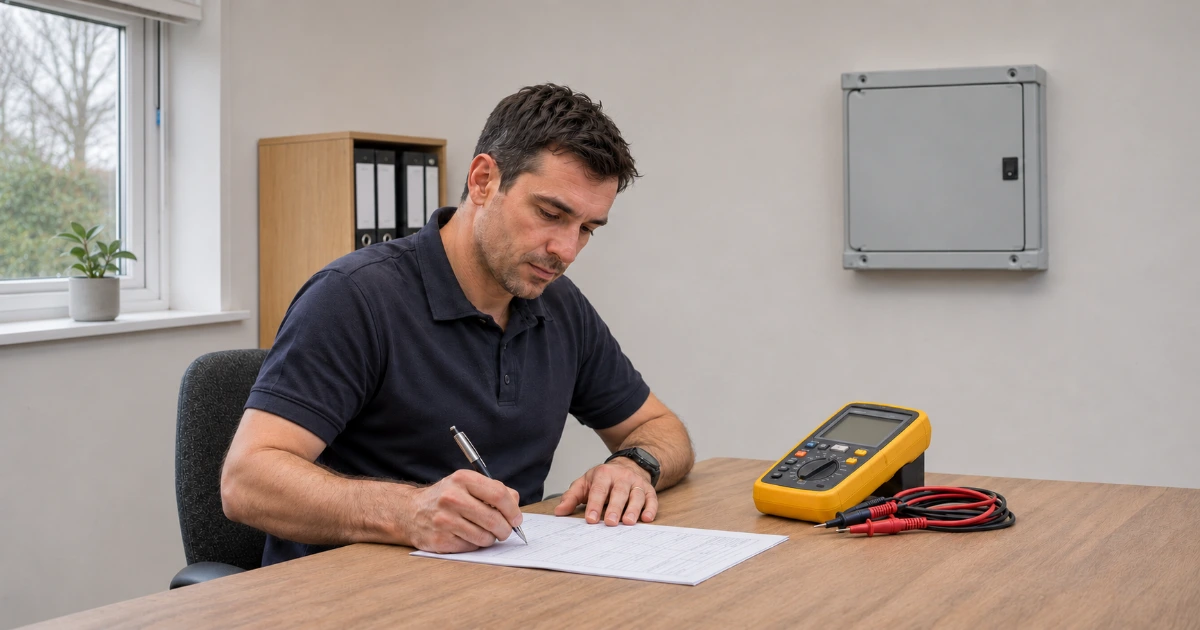
A qualified person, meaning someone competent to inspect and test the installation, can carry out an EICR, says GOV.UK. HSE says an installation should be inspected and tested by a person who has the competence to do so. GOV.UK points landlords to the Registered Competent Person Electrical register and the Electrical Safety First register of electricians. Solar panels or battery storage may need a separate inspection.
How can I arrange an EICR?
Checks Sorted can pass your EICR enquiry to a participating independent professional near you, and our EICR cost guide shows what affects quotes. We do not carry out inspections ourselves. It takes four steps:
- Pick the EICR
Choose it from the list of services. - Add your details
Give the postcode and a few facts about the property. - Get matched
Checks Sorted looks for a participating professional covering your area. - Agree the job
The professional contacts you to settle the day, the work and the price.
Is an EICR a Legal Requirement? FAQs
Do HMO landlords need an EICR?
Yes, in England the rules apply to HMOs, says GOV.UK. They cover properties let to people who are not one household but share facilities such as the bathroom and kitchen. GOV.UK calls a property like this occupied by more than 3 people an HMO.
Do I need an EICR if I rent out a room in my own home?
No, not under the England landlord rules, because GOV.UK lists shared accommodation with the landlord or the landlord’s family as an exception. We found no official page on the position in Wales, Scotland or Northern Ireland, so check that nation’s guidance before letting.
Do landlords also have to test appliances?
Only social landlords in England must, because GOV.UK lists the appliance check duty for them. They must have the equipment they provide, such as cookers, fridges and microwaves, checked by a qualified person at least every 5 years. Tenants are responsible for making sure their own equipment is safe.
Who pays for an EICR?
In Scotland the landlord pays, says the Scottish Government, because tenants cannot be required to pay for or contribute to an inspection unless the First-tier Tribunal orders it. We found no official page on who pays in England, Wales or Northern Ireland, so check your nation’s guidance.
Do communal areas need an EICR?
No, not under the England landlord rules, because GOV.UK says the regulations do not apply to communal areas such as stairwells and corridors. A council can still issue enforcement notices for communal electrical systems under other legislation, such as the Housing Act 2004, so those systems should be checked and maintained.
Sources
- GOV.UK: Electrical safety standards in the private and social rented sectors, guidance
- legislation.gov.uk: Renting Homes (Fitness for Human Habitation) (Wales) Regulations 2022, regulation 6
- Scottish Government: Repairing Standard statutory guidance for private landlords
- Department for Communities: Electrical safety standards in private tenancies, Northern Ireland
- legislation.gov.uk: The Electrical Safety Standards in the Private Rented Sector (England) Regulations 2020
- Welsh Government: Fitness for human habitation, guidance for tenants (contract holders)
- Law Society: TA6 Property information form (6th edition), explanatory notes
- legislation.gov.uk: The Electricity at Work Regulations 1989, regulation 4
- legislation.gov.uk: The Electricity at Work Regulations 1989, regulation 3
- HSE: Electrical safety FAQs