
On this page
When does a property need an EPC?When is an EPC not required to sell or rent a property?Do I need an EPC if I live in my own home?Which types of buildings can be exempt from needing an EPC?Do commercial properties need an EPC?Does every house sale need an EPC?Do I need an EPC for a new build or after an extension?How do EPC exemptions differ across the UK?What is the difference between an EPC exemption and a MEES exemption?How can I check whether my property needs an EPC?What happens if I do not have an EPC?How can I arrange an EPC?FAQs about when an EPC is not requiredSources
Checks Sorted does not carry out EPC assessments or issue certificates itself. We match your enquiry with a participating independent professional, where we can.
Key facts
- In England and Wales a building only needs an EPC when it is constructed, sold or let, says the GOV.UK statistics notes.
- Exempt buildings include temporary buildings, places of worship and stand-alone buildings under 50 square metres, says GOV.UK.
- A listed building is exempt only if the energy work would unacceptably alter its character or appearance.
- Holiday accommodation rented out for less than 4 months a year does not need an EPC, says GOV.UK.
- In Scotland places of worship and historic buildings have no general exemption, says the Scottish Government.
When does a property need an EPC?
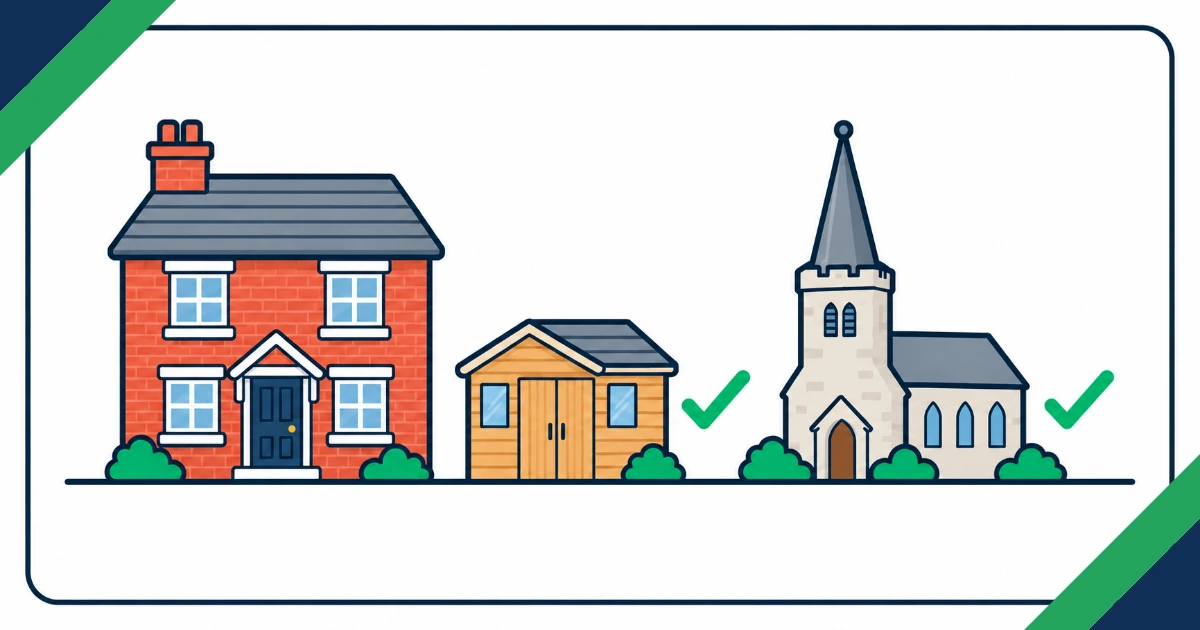
A property needs an EPC when it is built, sold or rented. The GOV.UK statistics notes say buildings only require an EPC when they are sold, let or constructed in England and Wales. GOV.UK says a property needs a valid EPC before it is prepared for sale or rent, and that the seller, the landlord or the letting agent must show it to anyone buying or renting.
A new building needs one once it is finished, says GOV.UK. You can be fined if you do not get an EPC when you need one.
When is an EPC not required to sell or rent a property?
You can sell or rent a property without an EPC only when an exemption applies. GOV.UK lists the exempt buildings, and regulation 8 sets the conditions for a dwelling that is going to be demolished.
Do you need a new EPC when you renew or extend a lease?
No, not in Scotland: an EPC does not have to be provided when an existing tenant renews their lease, says the Scottish Government. A new EPC is also not needed when the 10 year validity ends, unless the property is sold or let to a new tenant. In Northern Ireland, the Department of Finance says a lease assignment counts as a sale, so an EPC is needed.
Do you need an EPC to rent out a room or a self-contained flat?
You need an EPC for a self-contained flat but not for a single room with shared facilities. The Scottish Government says an EPC is required for each self-contained dwelling, and not where a tenant rents a room with shared access to the bathroom or kitchen. The Department of Finance says the same applies in Northern Ireland.
Can you sell or let a building without an EPC if it will be demolished?
Yes, but only if the conditions in the regulations are met. For a dwelling, regulation 8 requires that it is suitable for demolition, the site is suitable for redevelopment, and the planning permissions and consents are in place. In Scotland, buildings sold for demolition are exempt, says the Scottish Government.
Do I need an EPC if I live in my own home?
No, you do not need an EPC for a home you own and live in unless you sell or rent it. The Department of Finance says you will not be required to produce an EPC if you are not selling or renting your property. The GOV.UK statistics notes say a building occupied by the same person since the regulations began has no requirement to have one. If you later sell or rent the home, GOV.UK says you need a valid EPC before you get it ready to sell or rent.
Our guide to why you need an EPC explains who needs one and what it is used for.
Which types of buildings can be exempt from needing an EPC?
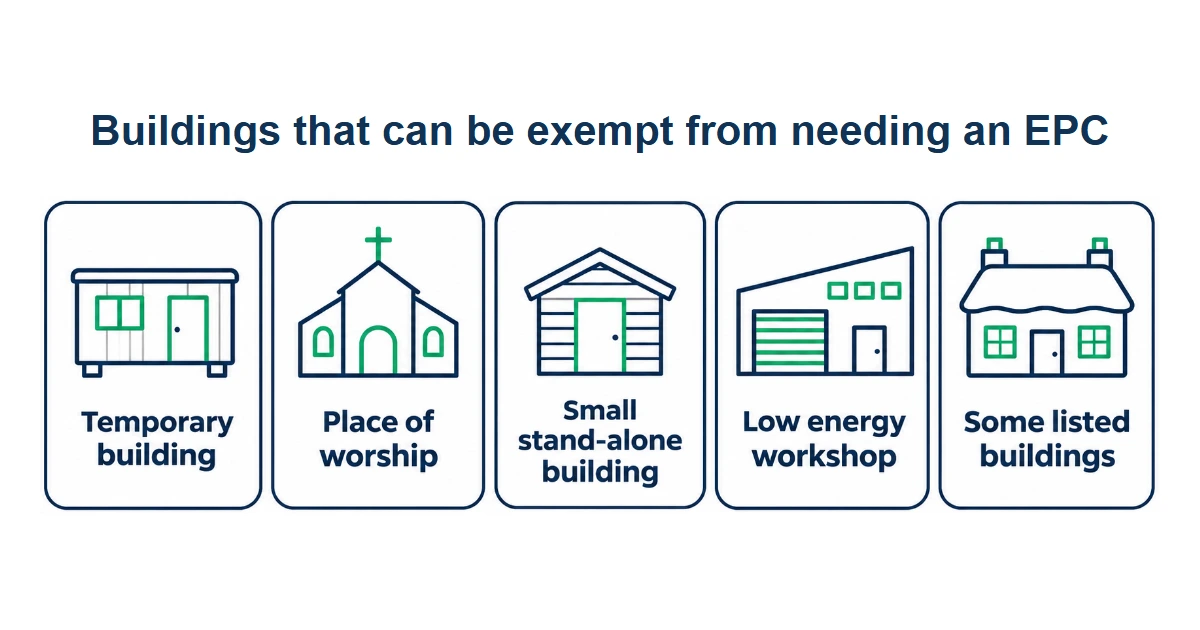
Temporary buildings, places of worship, stand-alone buildings under 50 square metres, low energy industrial and agricultural buildings, and some listed buildings can be exempt. Regulation 5 lists these energy performance certificate exemptions for England and Wales.
Do listed buildings need an EPC?
Only sometimes: a listed building is exempt only if meeting the minimum energy performance requirements would unacceptably alter its character or appearance. GOV.UK says to check with your local authority’s conservation officer about an EPC for listed buildings. Regulation 5 also covers buildings officially protected as part of a designated environment, and Scotland has no general exemption for historic buildings.
Do holiday lets need an EPC?
Not always: a holiday let does not need an EPC if it is rented out for less than 4 months a year or let under a licence to occupy, says GOV.UK. The same page exempts residential buildings intended to be used less than 4 months a year. Regulation 5 adds buildings with a limited annual time of use and low expected energy consumption.
Does a stand-alone building under 50 square metres need an EPC?
No, a stand-alone building with a total useful floor area of less than 50 square metres does not need an EPC, according to GOV.UK. In Scotland and Northern Ireland the exemption covers buildings that are not dwellings, so a small home is not automatically exempt there.
Do temporary buildings need an EPC?
No, a temporary building does not need an EPC if its planned time of use is 2 years or less. GOV.UK gives this for business premises, and the Scottish Government and the Department of Finance give the same limit.
Do places of worship need an EPC?
Not in England, Wales or Northern Ireland, but Scotland has no general exemption for a place of worship. GOV.UK lists places of worship as exempt, and the Scottish Government says they are not exempt unless they fall into another listed category.
Do industrial workshops and agricultural buildings need an EPC?
No, industrial sites, workshops and non-residential agricultural buildings do not need an EPC if their energy demand is low. GOV.UK gives this exemption. Regulation 5 also exempts non-residential agricultural buildings used by a sector covered by a national sectoral agreement on energy performance.
Do commercial properties need an EPC?
Yes, a commercial building needs an EPC when it is built, sold or rented, unless an exemption applies. GOV.UK says you must have a commercial EPC if:
- you rent out or sell the premises.
- a building under construction is finished.
- the parts used for separate occupation change and the change involves providing or extending fixed heating, air conditioning or mechanical ventilation.
The same page says a larger building must also display its EPC if it is over 500 square metres and frequently visited by the public.
Does every house sale need an EPC?
Not if an exemption applies, such as a dwelling that is due to be demolished, where regulation 8 sets the conditions. Otherwise a valid EPC is needed to sell, and the seller must make it available to prospective buyers free of charge. The timing, the penalty and the rules for each nation are in whether you need an EPC to sell a house.
Do I need an EPC for a new build or after an extension?
Yes, a new build needs an EPC when it is finished, but GOV.UK does not name an extension as a trigger. GOV.UK says a building under construction needs one once it is finished. Regulation 5 says no EPC has to be made available to a buyer or tenant before construction is complete.
In Northern Ireland, the Department of Finance says an EPC must be given to the owner when building work changes the number of parts designed for separate use and provides or extends fixed heating, hot water, air conditioning or mechanical ventilation. For an extension to a home, ask your local authority building control about your case.
How do EPC exemptions differ across the UK?
EPC exemptions differ most in Scotland and Northern Ireland, which have shorter lists than England and Wales. Scotland has no general exemption for places of worship or historic buildings, and Northern Ireland does not list historic buildings or holiday homes. The table compares each exemption using the GOV.UK, Scottish Government and Department of Finance lists.
| Exemption | England and Wales | Scotland | Northern Ireland |
|---|---|---|---|
| Temporary building, 2 years or less | Exempt | Exempt | Exempt |
| Stand-alone building under 50 square metres | Exempt | Exempt if not a dwelling | Exempt if not a dwelling |
| Place of worship | Exempt | No general exemption | Exempt |
| Low energy industrial or agricultural building | Exempt | Exempt | Exempt |
| Listed or protected building | Exempt only if the energy work would unacceptably alter it | No general exemption | Not on the official list |
| Holiday or seasonal home, under 4 months of use | Exempt | Not on the official list | Not on the official list |
| Building sold for demolition | Exempt if conditions are met | Exempt | Exempt if the buyer is expected to demolish |
What is the difference between an EPC exemption and a MEES exemption?
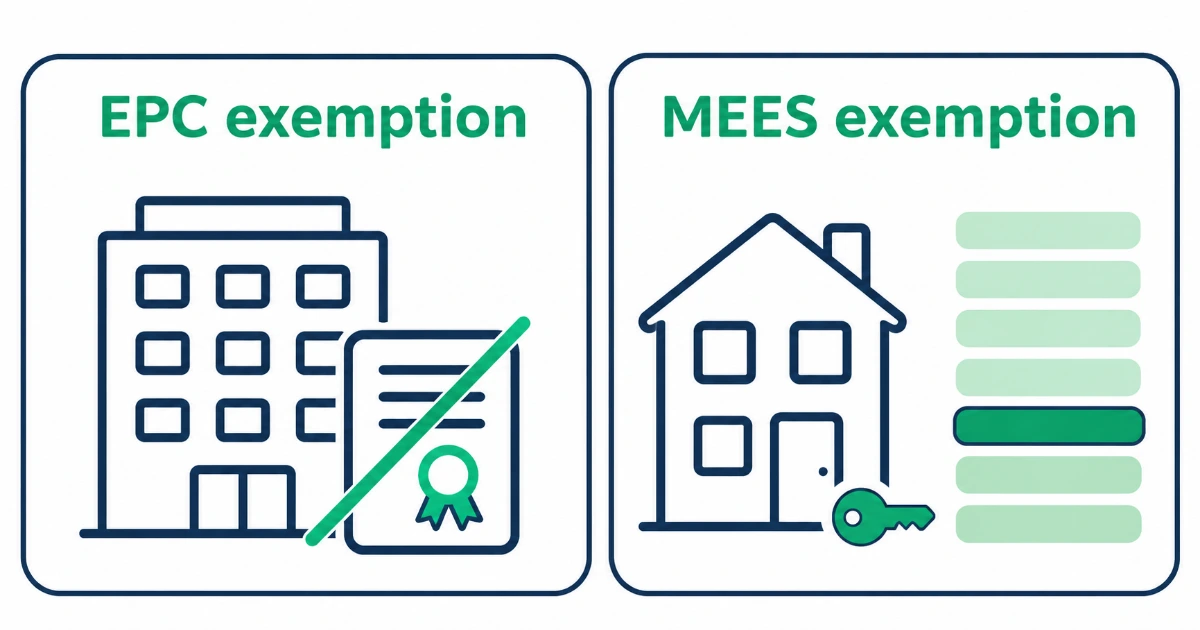
An EPC exemption means a building needs no EPC, while a MEES exemption lets a landlord rent out a property that has an EPC rating below E. MEES stands for minimum energy efficiency standards, the rules on the lowest EPC rating a private rental can have. Our guide on how EPC ratings are calculated explains what the A to G bands mean.
- EPC exemption: a type of building that needs no certificate at all, such as a temporary building.
- MEES exemption: a rental property that has an EPC but is rated below E and meets the criteria in the GOV.UK landlord guidance.
The two are separate, so one does not replace the other.
Can a rental property still need an EPC if it qualifies for a minimum rating exemption?
Yes, a rental property with a MEES exemption still needs an EPC, because the MEES Regulations apply only to properties that are legally required to have one. The exemption only lets the landlord keep letting a property that is rated below E.
When should a landlord use the PRS Exemptions Register?
A landlord should use the PRS (private rented sector) Exemptions Register when a rental property is below EPC E and meets the criteria for a MEES exemption. GOV.UK says:
- The landlord can let the property once the exemption is registered.
- Several exemptions last 5 years.
- The exemption for a new landlord lasts 6 months.
How can I check whether my property needs an EPC?
Your property needs an EPC if you are selling or renting it and it is not on the exemption list, so check those two things. If you are selling, our guide on whether you need an electrical certificate to sell a house covers the other paperwork a buyer may ask for. The result is one of three:
- Not selling or renting: you do not need an EPC.
- On the exemption list: you do not need an EPC either.
- Neither of these: you need a valid EPC.
How can I check if the property already has a valid EPC?
To check if a property already has a valid EPC, search the GOV.UK find an energy certificate service, or the Scottish EPC Register for a property in Scotland. Our guide on how to check your EPC rating gives the steps for each search.
Who can help me confirm whether an exemption applies?
Your local authority can help you confirm whether an exemption applies. GOV.UK says to check with the conservation officer of your local authority for a listed building. nidirect says to contact your local district council building control in Northern Ireland.
Do I need to register an EPC exemption?
No, the GOV.UK EPC pages do not ask you to register an exemption, but they say you must be able to demonstrate that the building is exempt. The only register GOV.UK describes is the PRS Exemptions Register, which landlords use for MEES exemptions.
What happens if I do not have an EPC?
You can be fined, according to GOV.UK. The amount depends on where the property is and what it is:
- England and Wales, a dwelling: £200 under regulation 38.
- England and Wales, a business building: between £500 and £5,000 based on rateable value, says GOV.UK.
- Scotland: a penalty charge notice of £500 or more is possible when letting, says the Scottish Government.
- Northern Ireland: enforcement action and a penalty charge notice are possible, says nidirect.
How can I arrange an EPC?
If your property needs an EPC, send Checks Sorted one enquiry and we match it with a participating independent professional in your area, where we can. We do not carry out assessments ourselves. It takes four steps:
- Say what you need
Select the property safety service you want. - Add the postcode
Enter the property postcode and any other details. - Get matched
Checks Sorted finds a participating professional for the service and the location. - Talk it through
The professional contacts you about availability, price and the work required.
FAQs about when an EPC is not required
Do landlords need an EPC to rent out a property?
Yes, landlords need a valid EPC for a rental property before renting it out, unless the building is exempt. GOV.UK adds that the landlord or letting agent must show the EPC to anyone who wants to rent, which is part of the EPC requirements for landlords. The minimum rating rule is separate and only applies to properties that legally need an EPC, says the landlord guidance.
Do I need a new EPC when mine expires?
No, not unless you sell or let the property. The GOV.UK statistics notes say buildings only require an EPC when they are sold, let or constructed in England and Wales, and the validity rules are in how long an EPC lasts.
Can one EPC cover a whole block of flats?
No, one EPC cannot cover a whole block of flats, because each self-contained flat that is sold or let needs its own certificate. The Scottish Government says a single certificate cannot be produced for an entire block, and the Department of Finance says Northern Ireland needs an EPC for each self-contained apartment when rented or sold. In England and Wales, regulation 2 counts an apartment designed to be used separately as a building unit, and a building unit is treated as a building.
Is an EPC needed when a lease is assigned?
Yes, an EPC is needed when a lease is assigned in Northern Ireland, because the Department of Finance says a lease assignment is treated as a sale. The person assigning the lease should provide the EPC.
Do I need an EPC when a housing association sells an extra share?
No, you do not need an EPC when a housing association sells an extra share to an existing shared owner in Scotland, says the Scottish Government. The pages read for England, Wales and Northern Ireland do not cover this case, so ask the local authority building control team there.
Sources
- GOV.UK: Selling a home, energy performance certificates
- GOV.UK: Energy Performance Certificates for your business premises
- GOV.UK: Domestic private rented property, minimum energy efficiency standard, landlord guidance
- GOV.UK: Energy Performance of Buildings Certificates in England and Wales, technical notes
- legislation.gov.uk: The Energy Performance of Buildings (England and Wales) Regulations 2012, regulations 2, 5, 6, 8 and 38
- Scottish Government: Energy Performance Certificates guide, exceptions
- Scottish Government: Energy Performance Certificates guide, buildings for let
- Department of Finance: Energy Performance Certificates frequently asked questions
- nidirect: Energy Performance Certificates
- GOV.UK: Find an energy certificate