
On this page
How much does an EICR cost for different properties?What affects the cost of an EICR?What does an EICR quote include?What will you pay if the EICR finds a fault?How can I save money on an EICR?How can I compare EICR quotes before booking?Who has to pay for an EICR in each UK nation?What is the difference between an EICR, an EIC and a PAT test?How can I get an EICR quote?How much does an EICR cost? FAQsSources
Checks Sorted does not carry out inspections or issue certificates itself. We match your enquiry with a participating independent professional, where we can.
Key facts
- In England a landlord must have the electrical installations inspected and tested by a qualified person at least every 5 years, says GOV.UK.
- NICEIC says the visit takes from a few hours for a small domestic property to a full day or longer for the largest premises.
- An EICR quote should name the inspection, the testing and the written report.
- The landlord holds the legal duty to arrange the inspection in all four nations, but we found no official page on who pays the cost.
- In England a council may impose a financial penalty of up to £40,000 on a landlord in breach, says GOV.UK.
How much does an EICR cost for different properties?
Each type of property is quoted separately, and the larger or more complex it is, the more inspecting and testing the electrician has to do. NICEIC says the time an EICR takes varies with the size of the property and the size and complexity of its electrical systems, from a few hours for a small domestic property to a full day or even multiple days for the largest residential, commercial or industrial premises. The cost moves with the same factors, so ask for a quote for your own property rather than relying on an average.
How much does an EICR cost for a flat or house?
A flat or house is priced by its size and the complexity of its wiring, so the electrician quotes for that home. NICEIC says the price varies with the size of the property and the scale and complexity of its electrical systems. When you ask for a quote, tell the electrician the number of bedrooms, whether there is more than one consumer unit, and whether any outbuilding has its own supply.
How much does an EICR cost for a house in multiple occupation (HMO)?
An HMO is quoted as a whole building, and the price follows its size and the complexity of its electrical systems. GOV.UK says the regulations apply to properties rented out by people who are not from one household but who share facilities such as the bathroom and kitchen, so an HMO in England needs an inspection and test at least every 5 years like any other rented home. NICEIC says the size of the property and the scale and complexity of its electrical systems affect the cost, so give the electrician the number of rooms and any separate supplies.
How much does an EICR cost for a shop, office or other commercial property?
Business premises are quoted one by one, and the size and complexity of the installation decide the price. NICEIC says larger commercial premises can take a full day or multiple days to inspect, and strongly recommends that business owners obtain an EICR at least once every five years. The Electricity at Work Regulations 1989, regulation 4 require systems to be maintained so as to prevent danger so far as is reasonably practicable, but the regulation sets no inspection interval.
What affects the cost of an EICR?
The size of the property, the scale and complexity of its electrical systems, and what the electrician charges decide the cost of an EICR. NICEIC names these three factors and says the cost can vary drastically between properties. A larger property has more to inspect and test, and a more complicated installation needs more testing, including the testing of circuits. Inspectors also charge differently, so two registered electricians can quote different amounts for the same property.
| Factor | What to tell or ask the electrician | Source |
|---|---|---|
| Size of the property | Give the number of bedrooms or rooms, and say if there are outbuildings | NICEIC |
| Scale and complexity of the electrical systems | Give the number of consumer units and circuits, if you know them | NICEIC |
| What the electrician charges | Ask what the price includes, such as the written report, VAT and travel | NICEIC |
How do the number of circuits and consumer units change the price?
More circuits and consumer units add to the scale and complexity of the electrical system, which NICEIC says affects the cost of an EICR. NICEIC describes the testing as including testing of circuits, so each extra circuit is more to test. A home with one consumer unit and a few circuits is simpler to quote than one with several consumer units, so give the electrician the numbers if you know them.
Do the age and layout of the installation matter?
They can matter through the complexity of the installation, which NICEIC names as a cost factor. Electrical Safety First says all electrical installations deteriorate with age and use, and that the inspection looks at the type of wiring system, its condition and the extent of wear and tear. Ask the electrician whether the age of your installation changes the quote.
Do location, access and out-of-hours visits cost more?
They can, because the electrician sets the charge and NICEIC says what an inspector typically charges varies. We found no official page that names travel, access or out-of-hours work as set charges, so ask each electrician whether any of them are in the quote before you accept it.
How long does an EICR take, and does it change the price?
An EICR takes from a few hours for a small domestic property to a full day or longer for the largest premises, and the size and complexity that decide the time also affect the price. NICEIC says the inspector can give you a time estimate, so ask for one with your quote. Our guide on how long an EICR takes covers the visit in full.
What does an EICR quote include?
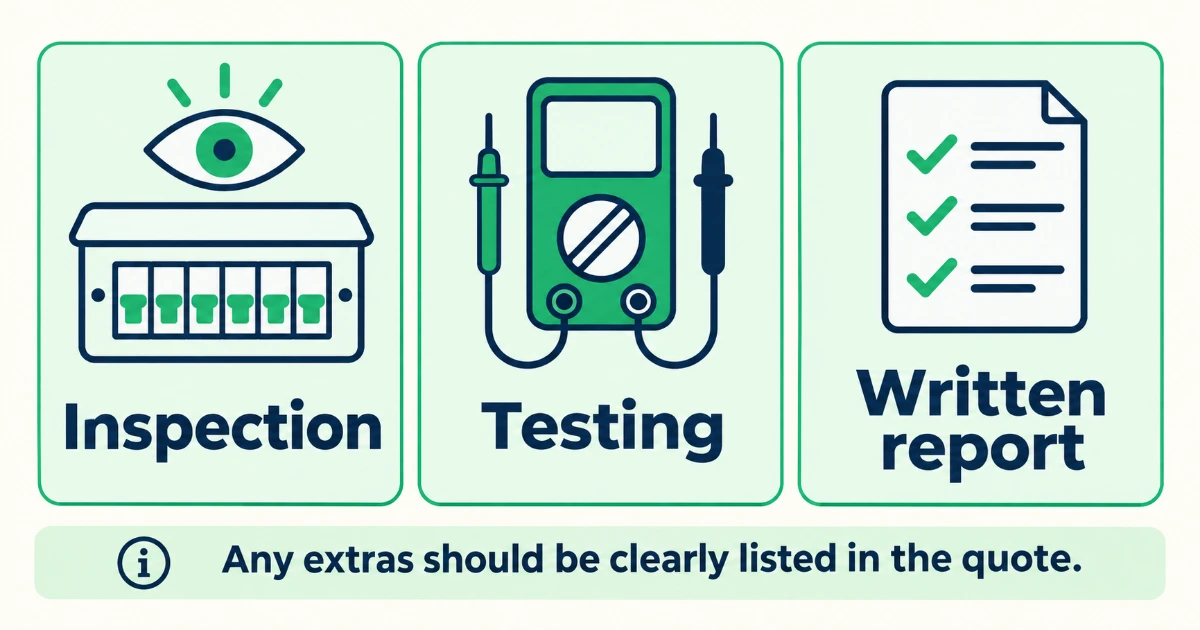
An EICR quote should cover the inspection, the testing and the written report, and the electrician should name anything else. GOV.UK says the person who conducts the inspection and test gives the landlord a report, usually an EICR, which explains the outcomes and any investigative or remedial work required. Electrical Safety First says the electrically competent person issues the report, so the report is part of the job and not an extra. Remedial work is separate, so ask for it to be named in the quote.
Does the quote include the inspection, testing and written report?
Yes, and the quote should say so. NICEIC describes a visual inspection followed by the testing of circuits, so ask the electrician to name three things in writing: the inspection, the testing of circuits and the written report you will receive. If a quote gives only a price, ask what it covers before you accept, because the report is the document you keep. GOV.UK names BS 7671, the 18th edition of the Wiring Regulations, as the standard the installation has to meet, so the inspection checks the installation against it.
Are VAT, extra circuits and other charges extra?
They can be, so check whether each one is in the figure, because the electrician decides how to present the price and what it includes. We found no official rule that sets what an EICR quote must list beyond the report. Before you accept, ask whether VAT, travel and any extra circuits are included, and get the answer in writing.
How is the price of a typical house built up?
The price of an EICR for a typical house is built from the size of the property, the number of circuits and the electrician’s own charge. NICEIC says the inspector can give a time estimate based on your property and circumstances. A typical quote is built in these steps:
- The electrician asks about the property, such as its size, the number of consumer units and whether it is rented.
- They estimate the time the inspection and testing will take.
- They price that time and the written report with their own charge.
- They list anything that is extra or not included.
Does the electrician have to be registered?
In practice, yes: the law asks for a qualified person, meaning a person competent to inspect and test. GOV.UK points landlords to the Registered Competent Person Electrical register and to the find a registered electrician tool from Electrical Safety First when choosing one. Electrical Safety First says inspection and testing should be carried out only by electrically competent persons, such as registered electricians, and NICEIC says the laws across the UK nations require a qualified, skilled or competent inspector.
What will you pay if the EICR finds a fault?
The cost of putting a fault right depends on the work needed, and in England the landlord must complete any remedial work within 28 days, or sooner if the report says so. GOV.UK says each observation in the report is given a code, and the code decides what happens next. The electrician who finds the fault can tell you what putting it right involves, so ask them to explain each code in plain words and to name the work and the time it needs.
What do the codes C1, C2, C3 and FI mean for the cost?
A C1 or C2 code means remedial work is required, a C3 code is only a recommendation, and an FI code means further investigation is needed first. GOV.UK sets out each code:
| Code | What it means | What happens next |
|---|---|---|
| C1 | Danger present. Risk of injury | Remedial work is required and the report is unsatisfactory. The inspector may make the hazard safe before leaving the premises |
| C2 | Potentially dangerous | Remedial work is required and the report is unsatisfactory |
| C3 | Improvement recommended | Remedial work is not required for the report to be satisfactory, and landlords do not have to make the improvement |
| FI | Further investigation required without delay | The landlord must ensure the investigation is carried out |
Who pays for repairs and further investigation?
The landlord is responsible for having remedial work and further investigation done, but we found no official page on how a landlord and tenant share the cost. GOV.UK says that where the report shows remedial or further investigative work is necessary, the landlord must complete it within 28 days, or any shorter period the report specifies. If a landlord does not act on a remedial notice, GOV.UK says the local council can arrange the work itself and recover the costs from the landlord, who has the right of appeal against a demand for costs.
Will you pay for a return visit or retest?
No official source says what a return visit or retest costs, so ask the electrician before you book. In England the landlord must send the tenant and the local council the report and written confirmation from the qualified person who carried out the remedial work, within 28 days of completing it, according to GOV.UK. Ask whether the price includes that written confirmation of the completed work.
How can I save money on an EICR?
Compare several written quotes for the same job, which NICEIC advises, because it gives you a better understanding of what an EICR will cost for your particular property. Three more steps help you avoid paying for work you do not need:
- Give every electrician the same details about the property, so the quotes can be compared fairly.
- Use the report you already have. In England a new tenancy does not need a new inspection if the last report is less than 5 years old and does not require further work, according to GOV.UK, which also says the landlord must keep a copy until the next inspection and test and give it to the inspector who does the next one.
- Do not book a new EICR just to prove repairs are done. Electrical Safety First says a failed EICR alongside documentation of the remedial work completed is enough to comply, so keep those documents.
How can I compare EICR quotes before booking?

Compare EICR quotes by asking every electrician to quote for the same property and the same job. NICEIC says requesting a quote from a number of providers gives you a better understanding of what an EICR will cost for your property. Keep every quote in writing so you can compare them side by side, and ask each electrician the same questions: what the price includes, who will carry out the work and whether the written report is part of the price. A quote that is much lower or higher than the others is a reason to ask what it includes, not a reason to choose or reject it.
What should I tell the electrician to get an accurate quote?
Tell the electrician the details that decide the size and complexity of the job, because the quote is for your property. NICEIC says the inspector can estimate the time from your property and circumstances. Give them:
- The type of property: flat, house, HMO or business premises.
- The size, such as the number of bedrooms or rooms.
- The number of consumer units and circuits, if you know them.
- Whether the home is rented, and whether the tenant needs to give access.
What should I check before accepting a quote?
Before you accept, check that the electrician is registered, that the quote covers the written report, and that anything extra is named. NICEIC says registered electricians are subject to regular assessments of their work, and GOV.UK says the person who inspects and tests gives the landlord the report. Also ask what happens if the inspection finds faults, and whether VAT is included.
Who has to pay for an EICR in each UK nation?
The landlord holds the legal duty to arrange the inspection in all four nations, but we found no official page that says who pays the cost, so the table shows only who holds the duty. For a sale, Electrical Safety First advises an inspection before selling a property or buying a previously occupied one, but we found no official page that says whether the buyer or the seller pays, so agree it between you before booking.
| Nation | Who holds the duty | Source |
|---|---|---|
| England | The landlord must have the electrical installations inspected and tested by a qualified person at least every 5 years, under the Electrical Safety Standards in the Private Rented Sector (England) Regulations 2020 | GOV.UK |
| Wales | A landlord is required to have the electrical installation tested every 5 years, unless the previous report requires a shorter interval | Welsh Government |
| Scotland | Landlords are required to ensure an electrical safety inspection is carried out, before the first let and then at intervals of no more than 5 years | Scottish Government |
| Northern Ireland | Landlords must have the electrical installations in their properties inspected and tested at least every 5 years, and keep ultimate responsibility even when an agent acts for them | Department for Communities |
What is the difference between an EICR, an EIC and a PAT test?
An EICR checks an existing installation, an EIC confirms new electrical work, and a PAT test checks portable appliances. NICEIC says an EIC is issued after a new installation or major alteration, while an EICR checks existing installations to confirm they are still working safely. It adds that portable items you plug in are generally not part of the electrical installation, so an EICR does not replace a PAT test. Our guide on what an EICR is explains the report in full.
| Document or test | What it covers | When it is used |
|---|---|---|
| EICR | The fixed electrical installation as it is now | At regular intervals, as the rules for your nation set |
| EIC (Electrical Installation Certificate) | New installation work or a major alteration | After the new work is completed |
| PAT test | Portable electrical appliances | As the rules for your property type require |
How can I get an EICR quote?
To get an EICR quote, send one enquiry to Checks Sorted and we match it with a participating independent professional in your area, where we can. We do not visit or test properties ourselves, and you discuss the price with the professional. The enquiry has four steps:
- Pick the service
Choose the property safety service you require. - Give the postcode
Enter the property postcode and any relevant details. - Wait for the match
Checks Sorted selects a participating professional who covers the service and the location. - Agree the details
The professional contacts you to discuss availability, price and the work needed.
How much does an EICR cost? FAQs
How much does an EICR certificate cost?
An EICR certificate costs the same as an EICR, which the electrician quotes for your property, because an EICR is a report that many people call a certificate. GOV.UK says the person who inspects and tests gives the landlord a report, usually an EICR, and NICEIC says the cost varies with the size of the property, the complexity of its electrical systems and what the inspector charges.
Does a landlord EICR cost more than a homeowner EICR?
No. The price depends on the property, not on who owns it. NICEIC names the size of the property, the complexity of its electrical systems and what the inspector charges as the factors, and the owner’s status is not among them. The legal duty differs: landlords must have the inspection, while Electrical Safety First advises one every 10 years for an owner-occupied home.
Does an EICR renewal cost the same as the first inspection?
Not necessarily, because each EICR is quoted for the property as it is when you ask. NICEIC says the cost varies with the size of the property, the complexity of its electrical systems and what the inspector charges, and any of these can change between inspections. Ask for a fresh quote each time rather than assuming the last price.
Can I save by booking EICRs for several properties together?
You might, but any discount is for the electrician to offer, so ask when you request quotes. We found no official page that says electricians must give one. NICEIC advises requesting quotes from a number of providers, and giving each the list of properties lets you compare the totals.
Do I need a new EICR for a new tenant?
No, not if the last EICR is less than 5 years old and does not require further investigative or remedial work. GOV.UK says a new inspection and testing is not required in that case, and the landlord must supply a copy of the most recent report to the new tenant before they occupy the premises, so you do not pay for a repeat inspection.
What is the penalty if a landlord has no EICR?
In England a local council may impose a financial penalty of up to £40,000 on a landlord who is in breach of specified duties under the regulations. GOV.UK says landlords have 28 days to make written representations against a penalty and then have a right of appeal. Wales, Scotland and Northern Ireland have their own rules, as the table above shows.
Is an EICR a legal requirement?
Yes for privately rented homes, under each nation’s own rules. Electrical Safety First says the inspection is a legal requirement across the whole of the UK for privately rented homes. It is advice, not a legal duty, for a home you own and live in. Our guide on whether an EICR is a legal requirement covers each nation.
How often do I need an EICR?
At least every 5 years for a rented home, or by the date the report sets if that is sooner. GOV.UK says the report sets the date for the next inspection and test, and Electrical Safety First advises every 10 years for an owner-occupied home. Our guide on how long an EICR lasts covers each nation.
Can I do an EICR myself?
No, an EICR should be carried out only by an electrically competent person. Electrical Safety First says periodic inspection and testing should be carried out only by electrically competent persons, such as registered electricians, and NICEIC says an EICR involves specialised tests and equipment and should never be a DIY job.
Do I need an electrical certificate to sell a house?
Electrical Safety First advises an inspection before selling a property, or before buying a previously occupied one, but we found no official page that makes it a legal rule for a sale. Our guide on whether you need an electrical certificate to sell a house covers what a buyer may ask for.
Sources
- GOV.UK: Electrical safety standards in the private and social rented sectors, guidance
- Welsh Government: Fitness for human habitation, guidance for landlords
- Scottish Government: Repairing Standard statutory guidance for private landlords
- Department for Communities: Electrical Safety Standards for Private Tenancies Regulations (Northern Ireland) 2024
- Electrical Safety First: Periodic inspection and testing
- NICEIC: Electrical Installation Condition Reports
- legislation.gov.uk: Electricity at Work Regulations 1989, regulation 4