
On this page
How often should a fire risk assessment be reviewed by law?When should a fire risk assessment be reviewed sooner than planned?What is the difference between a review and a new fire risk assessment?What should a fire risk assessment review include?Who can review a fire risk assessment?What should you do after reviewing a fire risk assessment?How do fire risk assessment review duties differ across the UK?What happens if you do not review your fire risk assessment?How can I arrange a fire risk assessment?FAQs: when should a fire risk assessment be reviewed?Sources
Checks Sorted does not carry out fire risk assessments itself. We match your enquiry with a participating independent professional, where we can.
Key facts
- The law sets no fixed review period. Article 9(3) says to review regularly so the assessment stays up to date.
- Review sooner if you suspect it is no longer valid or there is a significant change to the premises, occupants or management, or after a fire, says GOV.UK.
- An annual review is recognised as good practice for small and simple premises, and your assessor should advise on the right frequency.
- A review is not necessarily a new assessment. Check that actions are done, nothing has changed and fire safety measures have not deteriorated.
- Make the changes the review shows, record the review and action significant findings within the designated period.
How often should a fire risk assessment be reviewed by law?
Regularly, but the law does not say how often. Article 9(3) of the Fire Safety Order says the assessment must be reviewed regularly so as to keep it up to date, and particularly if there is reason to suspect it is no longer valid or there has been a significant change. The GOV.UK guide says the right frequency varies with the circumstances, complexity and risk of the premises, and that your fire risk assessor should advise you.
Is an annual fire risk assessment review a legal requirement?
No, the Order does not require an annual review. The GOV.UK guide says an annual review is recognised as good practice for small and simple premises. For accommodation where people sleep, GOV.UK’s guide for small paying guest accommodation says an annual review is usually appropriate, but you must also review after any significant change or an incident such as a fire.
Is there a 3, 4 or 5 year rule?
No. None of the Order, the Scottish Regulations, GOV.UK or nibusinessinfo sets a three, four or five year period. The legal duty is regular review, plus review after a significant change or reason to doubt the assessment. If someone quotes a longer fixed interval, ask which official source it comes from.
How do you choose the right fire risk assessment review period?
Start with your assessor’s advice. The GOV.UK guide says your fire risk assessor should advise how often to review, and that the right frequency depends on circumstances, complexity and risk. Larger or more complex premises, and premises with higher risk, can need shorter gaps or more frequent checks than a small simple office, so ask your assessor to put the review period in writing.
Does a fire risk assessment expire?
No, there is no fixed expiry date in law. A fire risk assessment stays valid only while it is kept up to date, so how long a fire risk assessment is valid depends on your premises, not on a date. Once you have reason to suspect it is no longer valid, article 9(3) requires a review.
When should a fire risk assessment be reviewed sooner than planned?
Review it as soon as you have reason to suspect the assessment is no longer valid or there has been a significant change. The GOV.UK guide gives significant changes to the premises, the occupants or the management of the premises, and a fire, as reasons to suspect it may no longer be valid. The table shows the main triggers, including the extra examples nibusinessinfo gives for Northern Ireland.
| Change | What the official pages say | Source |
|---|---|---|
| Premises, extensions or conversions | A significant change in the matters the assessment relates to, including significant changes, extensions or conversions, means review | Article 9(3) |
| Occupants or management | Significant changes to the occupants or to the management of the premises are reasons to suspect the assessment is no longer valid | GOV.UK guide |
| A fire | When a fire has occurred, arrange a review to make sure the assessment remains valid | GOV.UK guide |
| Northern Ireland examples | A fire caught in time, more flammable materials, a new night shift, more people using the premises, or an extension or subdivided offices | nibusinessinfo |
Do building work, layout changes or new uses mean a review?
Yes, if the change is significant. Article 9(3) names significant changes, extensions and conversions to the premises, and nibusinessinfo gives an extension, subdividing offices and storing more flammable materials as examples. Review before the work starts or the new use begins where you can, so the assessment is ready for the changed building.
What if fire safety measures fail or wear out?
Yes, include it in the review. The GOV.UK guide says a review can check that there has been no deterioration of fire safety measures, for example that fire doors still stop the spread of fire and smoke. Routine maintenance faults are separate, but a measure that no longer works can be a reason to suspect the assessment no longer matches the building.
Do you review after a fire or near miss?
Yes after a fire. The GOV.UK guide lists a fire as a reason to suspect the assessment is no longer valid, and nibusinessinfo lists a fire that was caught in time as a reason to look at it again. An incident that nearly became a fire is worth the same treatment, because it shows how your fire precautions held up.
What is the difference between a review and a new fire risk assessment?
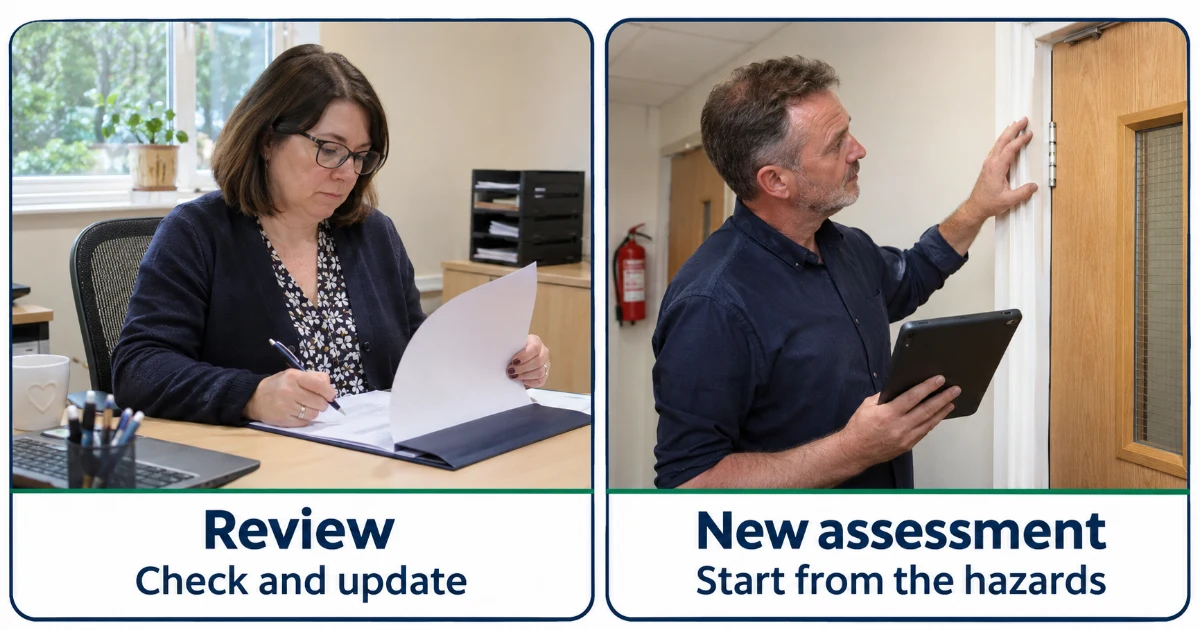
A review checks whether the existing assessment is still right and updates it, while a new assessment starts again from the hazards. The GOV.UK guide says a review does not necessarily involve carrying out a completely new fire risk assessment. If the review shows significant changes that might affect the fire risk, you may need to do another one.
When can you update the existing assessment?
When nothing significant has changed, update the existing assessment: tick off the actions that are done, amend any finding the review changed, and record the review. Keep the update proportionate, because the GOV.UK guide does not ask for a full reassessment each time.
When might you need a completely new assessment?
When the review shows significant changes, such as an extension, subdivided offices or more flammable materials, which nibusinessinfo gives as examples. If you are unsure whether a change is significant, do the full assessment, as nibusinessinfo advises, even if it turns out no further action is needed.
What should a fire risk assessment review include?
A review should check three things: whether the actions from the previous assessment were done, whether anything has changed in the premises or their management, and whether fire safety measures have deteriorated. The GOV.UK guide names these, and you update the assessment where they show a gap:
- Actions. Whether the measures identified as necessary in the previous assessment have been done.
- Changes. Whether anything has changed in the premises or their management that affects fire risk, including who uses the building.
- Deterioration. Whether fire safety measures still work, for example fire doors that still stop the spread of fire and smoke.
The guide also says significant findings must be actioned within the designated period, whether the responsible person or a professional assessor did the assessment.
Who can review a fire risk assessment?
The responsible person can review it if they are competent, or a competent person can do it for them. The GOV.UK guide describes a competent individual carrying out the review checks. Appoint a professional if you cannot keep the assessment suitable and sufficient yourself. Our guide to who can carry out a fire risk assessment explains competence, qualifications and how to check an assessor.
What should you do after reviewing a fire risk assessment?
Record the review, make the changes it shows, and action the significant findings within the designated period. Article 9 says the responsible person must make any changes a review shows are needed, and requires a record of the assessment or review. The GOV.UK guide says significant findings must be actioned within the designated period, whether the responsible person or a professional assessor did the assessment.
What should you record after a review?
A practical review record notes the date, who carried out the review, what had changed, and what was decided. Keep it with the assessment, because article 9(6) requires a record of each review and the GOV.UK guide says to keep the review records and the identity of anyone who assisted.
How should you handle actions after a review?
Action significant findings within the designated period, as the GOV.UK guide requires. Give each action an owner and a date, and keep a note of when it was done. The responsible person stays answerable for the actions, even if an assessor wrote the list.
When should you set the next review date?
Ask your assessor for the interval, then write the next review date in the assessment. The GOV.UK guide says the assessor should advise on frequency, and an annual review is good practice for small and simple premises. A change in the building, the people or the management can bring the date forward.
How do fire risk assessment review duties differ across the UK?
The basic duty is the same in each nation: review regularly, and review after a significant change or reason to doubt the assessment. The legislation and the record rules differ, as the table shows.
| Nation | Review rule | Written record | Source |
|---|---|---|---|
| England and Wales | Review regularly so it stays up to date, and particularly if there is reason to suspect it is no longer valid or there has been a significant change | A record of the assessment or review, including findings and groups at risk | Article 9 of the Fire Safety Order |
| Scotland | Review regularly so it stays up to date, and if there is reason to suspect it is no longer valid or there has been a significant change | Record the information where you employ five or more employees, a licence or registration is required, or an alterations notice requires it | Fire Safety (Scotland) Regulations 2006 |
| Northern Ireland | Review regularly, keep it up to date and take account of changes to the premises or business | Written record of significant findings if you employ more than five people, and good practice below that | nibusinessinfo |
What happens if you do not review your fire risk assessment?
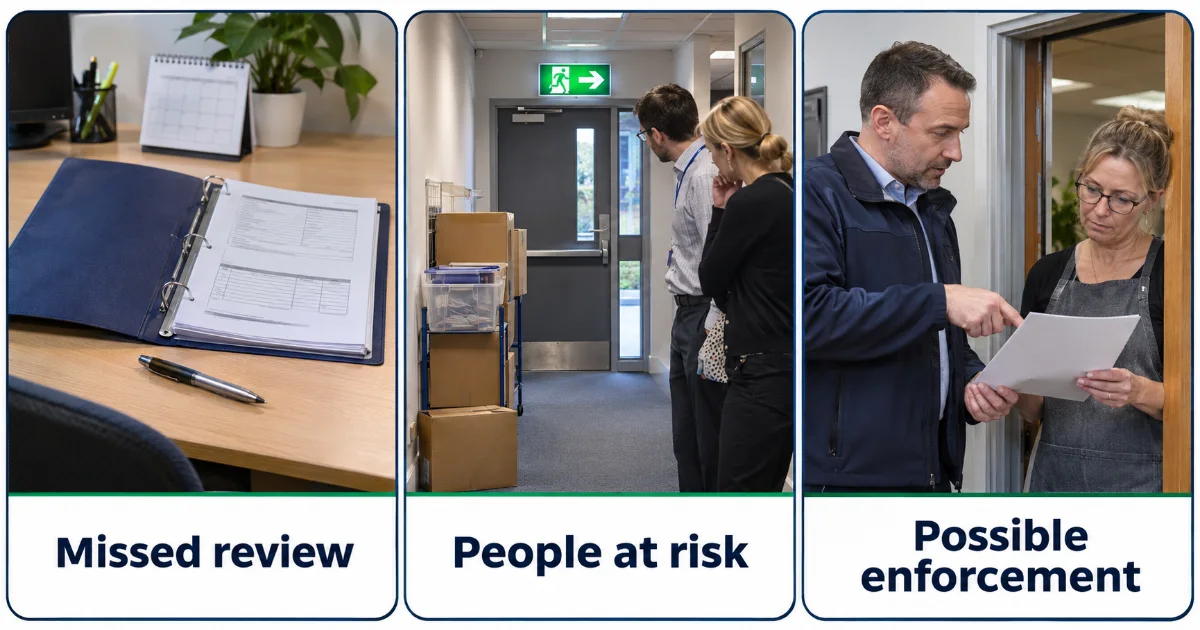
You can commit an offence if the failure puts people at risk. In England and Wales, article 32 makes it an offence to fail to comply with the fire safety duties in articles 8 to 22B where that puts one or more relevant persons at risk of death or serious injury in case of fire. GOV.UK says minor penalties can be up to £5,000, and major penalties can be unlimited fines and up to 2 years in prison. Our guide to who is responsible for a fire risk assessment covers who answers for a missed review.
How can I arrange a fire risk assessment?
Send Checks Sorted one enquiry for a fire risk assessment and we match it with a participating independent professional covering your area, where we can. If you want an existing assessment reviewed, say so in the enquiry. We do not carry out assessments ourselves. It takes four steps:
- Pick the service
Choose fire risk assessment from the list. - Give the property details
Add the postcode and the type of building. - Get a match
We look for a participating professional for the service and your area. - Agree the work
They contact you about the date, the scope and the price.
Check that they are competent for your type of premises, as the GOV.UK guide advises.
FAQs: when should a fire risk assessment be reviewed?
When should a fire risk assessment be reviewed if nothing has changed?
Regularly, even if nothing has changed, because the duty is to review regularly, not only after a change. The review can be a quick check that actions were done, nothing has changed and fire safety measures still work. The GOV.UK guide says an annual review is good practice for small and simple premises.
How often should a fire risk assessment be carried out?
There is no fixed legal interval. The assessment must be made first, then reviewed regularly so it stays up to date, and reviewed again after a significant change. Ask your assessor how often suits your premises, and see whether a fire risk assessment is a legal requirement for which premises need one.
Do routine fire alarm tests replace a fire risk assessment review?
No. Article 17 requires equipment and facilities to be maintained in an efficient state, which is a separate duty from reviewing the assessment. Alarm tests and servicing show the alarm works, but they do not check whether the assessment still matches your premises, people and management. See how often fire alarms should be tested for the testing rules.
Does a change of managing agent or owner mean a review?
It can. The GOV.UK guide lists significant changes to the management of the premises as a reason to suspect the assessment may no longer be valid. Check who is now the responsible person, then review the assessment and its records with your assessor.
Does a review need a professional fire risk assessor?
Not always. A competent responsible person or competent individual can carry out a review, which the GOV.UK guide describes as checking actions, changes and deterioration. Appoint a professional if you cannot keep the assessment suitable and sufficient yourself, or if the premises are complex.
Who is liable if a review is missed?
The responsible person is. In a workplace that is the employer, otherwise the person who controls the premises for a business, or the owner, says article 3. Hiring an assessor to carry out reviews does not move that duty.
Sources
- GOV.UK: Fire safety in the workplace, fire risk assessments
- GOV.UK: A guide for persons with duties under fire safety legislation (England)
- GOV.UK: Making your small paying guest accommodation safe from fire
- GOV.UK: Fire safety in the workplace, enforcement, appeals and penalties
- legislation.gov.uk: Regulatory Reform (Fire Safety) Order 2005, articles 3, 9, 17 and 32
- legislation.gov.uk: Fire Safety (Scotland) Regulations 2006, regulations 3 and 8
- nibusinessinfo: Fire safety, record, review and revise