
On this page
Is a fire risk assessment a legal requirement in the UK?When is a fire risk assessment required, and for which premises?Does a small business need a fire risk assessment?Do blocks of flats need a fire risk assessment?Do HMOs need a fire risk assessment?Do holiday lets, guest houses and B&Bs need a fire risk assessment?Do you need a fire risk assessment for your own home?What are the fire risk assessment requirements in England, Wales, Scotland and Northern Ireland?Does a fire risk assessment have to be written down?Is a professional fire risk assessor a legal requirement?Is BS 5839-1 a legal requirement?What are the five steps of a fire risk assessment, and what must it cover?How often must you review a fire risk assessment?Do you need a fire certificate or a fire risk assessment certificate?What happens if you do not have a fire risk assessment?How can I arrange a fire risk assessment?FAQs about whether a fire risk assessment is a legal requirementSources
Checks Sorted does not carry out fire risk assessments itself. We match your enquiry with a participating independent professional, where we can.
Key facts
- Yes for most non-domestic premises: all workplaces and commercial premises, all premises the public have access to and the common areas of multi-occupied residential buildings, says GOV.UK’s workplace fire safety page.
- Not for your own home. The Fire Safety Order does not apply to domestic premises, except the common parts of a building with two or more homes.
- Written record: in England and Wales every assessment and every review must be recorded, whatever the number of employees.
- Scotland and Northern Ireland: the record is required with five or more employees, a licence or registration, or an alterations notice.
- No professional assessor is required by law. You can do it yourself if you are competent.
- No fixed review date. The Order says review it regularly and after a significant change.
- Penalty: in every UK nation an offence tried on indictment can mean a fine, up to two years in prison, or both.

Is a fire risk assessment a legal requirement in the UK?
Yes, for most premises that are not a private home. The legal requirement for fire risk assessments in England and Wales is in article 9 of the Fire Safety Order, which says “The responsible person must make a suitable and sufficient assessment of the risks to which relevant persons are exposed”. The Order came into force on 1 October 2006 and extends to England and Wales only.
GOV.UK’s fire risk assessment page tells the responsible person to carry out the assessment, review it regularly and keep a written record. Scotland and Northern Ireland have their own laws, which are set out below.
When is a fire risk assessment required, and for which premises?
Non-domestic premises legally need a fire risk assessment, and so do premises with paying guests. GOV.UK’s workplace fire safety page lists them:
- All workplaces and commercial premises.
- All premises the public have access to.
- The common areas of multi-occupied residential buildings.
- Premises with paying guests, such as a bed and breakfast, guesthouse or self-catering property.
The responsible person is the employer, owner, landlord, occupier or anyone else with control of the premises. Who that is can depend on who controls each part, as we explain in who is responsible for a fire risk assessment.
Does a small business need a fire risk assessment?
Yes, a small business needs a fire risk assessment. A workplace fire risk assessment is required for every shop, office or other workplace or commercial premises, and the responsible person must carry it out whatever the size of the business. The Home Office guide for offices and shops is written for these premises.
If you rent space in a shared building, the duty can be split. The GOV.UK guide for England says “the terms of the lease will indicate the areas of the premises that each of the parties is responsible for maintaining”, so check the lease for the shared areas. In England and Wales the assessment must be written down, whatever the number of employees.
Do blocks of flats need a fire risk assessment?
Yes, a fire risk assessment for flats is required for the parts the residents share, such as the common areas. Where a building contains two or more sets of domestic premises, article 6 of the Fire Safety Order brings in “the building’s structure and external walls and any common parts” and “all doors between the domestic premises and common parts”.
The responsible person for common or shared areas is the landlord, freeholder or managing agent, says GOV.UK’s workplace fire safety page. A fire risk assessment is not required inside a private flat in England and Wales, because that is domestic premises.
For certain residential buildings in England, the Fire Safety (England) Regulations 2022 add duties such as displaying fire safety instructions and giving residents fire door information.
Do HMOs need a fire risk assessment?
Yes, the common parts of an HMO need one in England and Wales, and the Scottish and Northern Irish laws cover shared houses too. The GOV.UK guide for England says “The Fire Safety Order also applies to the common parts (communal corridors and stairways) of blocks of flats and houses in multiple occupation (HMOs)”, and describes an HMO as “a property rented out by at least three people who are not from one ‘household’ (for example a family) but share facilities like the bathroom and kitchen”.
In Scotland a house that must be licensed under Part 5 of the Housing (Scotland) Act 2006 is not domestic premises, so it is covered, under section 78 of the Fire (Scotland) Act 2005. In Northern Ireland a house in multiple occupation is not domestic premises, so it is covered, under article 50 of the Fire and Rescue Services (Northern Ireland) Order 2006. We found no official page on the rooms inside an HMO in England, so ask your local fire and rescue authority.
Do holiday lets, guest houses and B&Bs need a fire risk assessment?
Yes, a fire risk assessment for holiday lets, guest houses and B&Bs is required if you have paying guests. GOV.UK’s workplace fire safety page says “The Fire Safety Order also applies if you have paying guests, for example if you run a bed and breakfast, guesthouse or let a self-catering property.”
That covers a holiday let too. The GOV.UK paying guest guide for small accommodation names self-catering accommodation as an example and says “The law (FSO) applies to you if you are charging someone to stay in your property as a guest and it is not being occupied as a private dwelling, even if it is just for one night.” It adds that premises with short-term, temporary paying guests are unlikely to be occupied as a private dwelling.
The fire and rescue authority is the enforcing body, so ask it if you are unsure about a particular property. For larger guest accommodation, use the Home Office sleeping accommodation guide.
Do you need a fire risk assessment for your own home?
No, you do not need a fire risk assessment for your own home. The Fire Safety Order does not apply to a home lived in as a private dwelling. Article 6 says the Order “does not apply in relation to” domestic premises, and article 2 defines them as “premises occupied as a private dwelling”.
That includes a garden, yard, garage or outhouse that is not used in common by more than one home. The Order also excludes offshore installations, mines, borehole sites, a ship’s normal crew activities, agricultural or forestry land away from buildings, and vehicles used as transport. If you are a landlord of flats, the common parts are still covered.
What are the fire risk assessment requirements in England, Wales, Scotland and Northern Ireland?
UK fire risk assessment requirements differ by nation. All four nations require an assessment, but each has its own law. England and Wales share one Order, and Scotland and Northern Ireland each have an Act or Order with their own regulations.
| Nation | Law | Who must assess | Written record |
|---|---|---|---|
| England and Wales | Regulatory Reform (Fire Safety) Order 2005 | The responsible person | Yes, every assessment and review |
| Scotland | Fire (Scotland) Act 2005 | The employer for a workplace, and a person with control of relevant premises to any extent | With five or more employees, a licence or registration, or an alterations notice |
| Northern Ireland | Fire and Rescue Services (Northern Ireland) Order 2006 | The employer for a workplace, and a person with control of relevant premises to any extent | With five or more employees, a licence or registration, or an alterations notice |
What does the law require in England and Wales?
It requires the responsible person to assess the fire risks, record the assessment and keep it under review. The responsible person is the employer for a workplace, the person in control for a business, or otherwise the owner, and the fire and rescue authority enforces the Order. The inside of a private home is outside it.
Which premises fall under fire safety law in Scotland?
In Scotland, fire safety law covers relevant premises, which are any premises other than domestic premises, mines, offshore installations, normal ship-board crew activities, borehole sites and remote agricultural land, says section 78 of the Fire (Scotland) Act 2005.
Under section 54, an employer must assess the workplace and a person who has control to any extent of relevant premises must assess them. The owner must also comply where the person in control is neither running an undertaking there nor the owner.
What does the law require in Northern Ireland?
It requires an employer to assess the workplace and the person with control of relevant premises to assess them, under article 26 of the Fire and Rescue Services (Northern Ireland) Order 2006.
The Northern Ireland Fire and Rescue Service is the main enforcer, says nibusinessinfo’s appropriate person guide.
Does a fire risk assessment have to be written down?
Yes, in England and Wales a fire risk assessment must be written down every time. Article 9(6) says the responsible person must “make a record of the assessment or review”, with no employee threshold. That has applied since 1 October 2023, when the Building Safety Act 2022 changed it. Before then the record was only required with five or more employees, a licence, or an alterations notice.
The record must include the findings, including the measures taken or to be taken, and any group of people identified as especially at risk. GOV.UK’s fire risk assessment page puts it plainly: “You must keep a written record of your fire risk assessment.”
In Scotland and Northern Ireland the record is required where there are five or more employees, a licence or registration is required, or an alterations notice requires it, under Scottish regulation 8 and Northern Ireland regulation 8. It is still good practice to write it down in smaller premises.
Is a professional fire risk assessor a legal requirement?
No, the law does not require a professional assessor. It requires a competent person. GOV.UK’s fire risk assessment page says “You can do the fire risk assessment yourself with the help of standard fire safety risk assessment guides”, and appoint a competent person if you do not have the expertise or time.
In small premises the assessment is commonly carried out by the owner or occupier where they are competent to do so, says the GOV.UK guide for England. If you hire someone, you stay liable: “The Responsible Person is liable in law if the fire risk assessment is not suitable and sufficient.” Our guide to who can carry out a fire risk assessment covers competence, qualifications and how to check an assessor. The fire and rescue service cannot carry it out for you.
Is BS 5839-1 a legal requirement?
No, the Fire Safety Order does not mention BS 5839-1. The Home Office guide for offices and shops refers to it as further guidance: “New automatic fire detection systems should be designed and installed by a competent person. Further guidance is given in BS 5839-1 or a more recent standard where applicable.”
What the law asks for is a suitable and sufficient assessment, which decides what your premises need. The GOV.UK guide for England says that in small, single storey premises with few people, such as a small shop, a fire alarm system might be unnecessary. We found no official page that says in so many words whether BS 5839-1 is or is not a legal requirement.
What are the five steps of a fire risk assessment, and what must it cover?
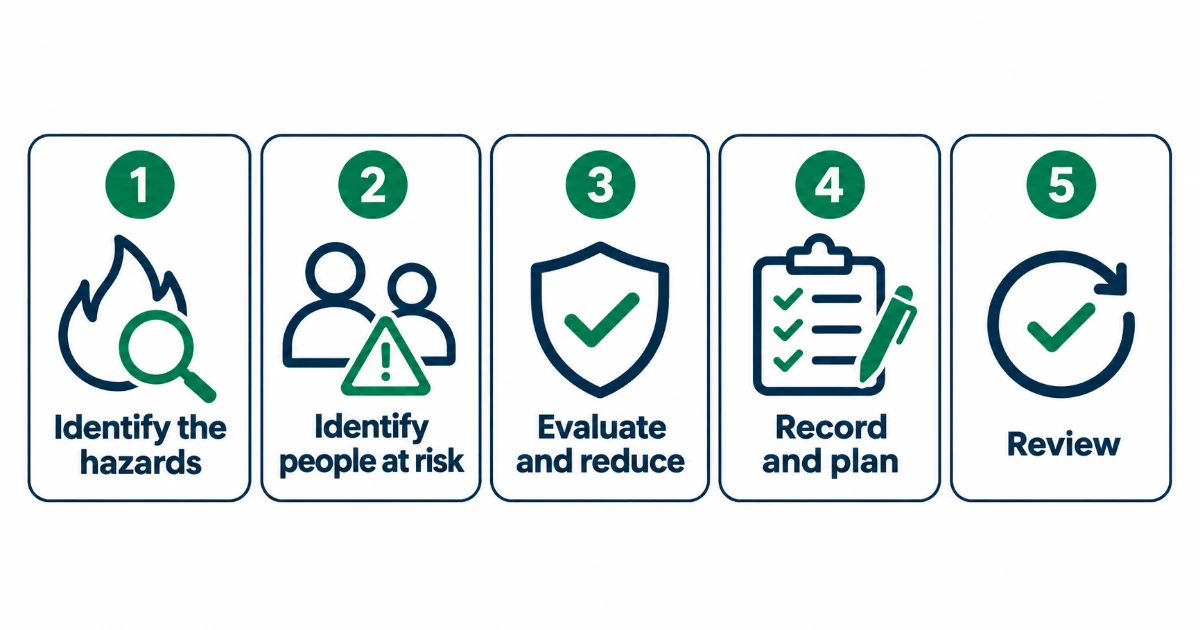
A fire risk assessment has five steps, says GOV.UK’s fire risk assessment page. The fire risk assessment must cover the following steps:
- Identify the fire hazards.
- Identify people at risk.
- Evaluate, remove or reduce the risks.
- Record your findings, prepare an emergency plan and provide training.
- Review and update the fire risk assessment regularly.
You will need to consider emergency routes and exits, fire detection and warning systems, fire fighting equipment, the safe storage of dangerous substances, an emergency evacuation plan, the needs of vulnerable people, information for employees and other people on the premises, and staff fire safety training.
How often must you review a fire risk assessment?
A fire risk assessment must be reviewed regularly and after any significant change. Article 9(3) says it “must be reviewed by the responsible person regularly so as to keep it up to date and particularly if” there is reason to suspect it is no longer valid or there has been a significant change in the matters it relates to.
Is there a legal requirement to renew it every year?
No, there is no legal requirement to renew a fire risk assessment every year. The GOV.UK guide for England says “While there is not a specified legal frequency around the need to review”. A review does not need to be a completely new assessment, and it can check that actions were taken and that nothing has changed or deteriorated.
Which changes should trigger a review?
Significant changes to the premises, the occupants or the management should trigger one, and so should a fire. The Order lists significant changes, extensions and conversions of the premises, and special, technical and organisational measures. Scotland and Northern Ireland have the same duty in regulation 3 of the Scottish regulations and regulation 3 of the Northern Ireland regulations.
Our guide to when a fire risk assessment should be reviewed covers the triggers, what a review includes and what to record.
Do you need a fire certificate or a fire risk assessment certificate?
No, you do not need a fire certificate or a fire risk assessment certificate in England and Wales. The Order replaced fire certificates and asks for a written record of the assessment, not a certificate. The Fire Safety Order “replaces fire certification under the Fire Precautions Act 1971”, and the Order states that “The Fire Precautions Act 1971 ceases to have effect.”
The responsible person now carries out the assessment, acts on it and records it under article 9(6). We read no official page on fire certificates in Scotland or Northern Ireland, so this answer covers England and Wales only.
What happens if you do not have a fire risk assessment?
The fire and rescue authority can serve notices on you, and you can be prosecuted. GOV.UK’s workplace fire safety page says “You could be fined or go to prison if you do not follow fire safety regulations.”
Who enforces fire safety law?
In England and Wales the fire and rescue authority is the enforcing authority for most premises and must enforce the Order, under article 25 and article 26. An inspector can enter premises, make inquiries and require records.
In Northern Ireland the Northern Ireland Fire and Rescue Service can serve an enforcement notice for major failings. In Scotland each enforcing authority must enforce the duties, under section 61 of the Fire (Scotland) Act 2005.
What can enforcement and prosecution mean in England and Wales?
An enforcement notice can follow any failure to comply, and it must give at least 28 days to put it right. A prohibition notice can prohibit or restrict the use of premises where the risk is “so serious” that use ought to be stopped, and it takes effect immediately if the risk of serious personal injury is imminent, under article 31.
It is an offence under article 32 to fail to comply with the fire safety duties where that places people at risk of death or serious injury in case of fire, or to fail to comply with an enforcement notice. On summary conviction the fine is “not exceeding the statutory maximum”. On indictment it is a fine, imprisonment for up to two years, or both. A director or manager can be guilty as well as the company.
What are the penalties in Scotland?
In Scotland, failing an assessment duty under section 53 or 54 is an offence where it puts a relevant person at risk of death or serious injury in the event of fire, under section 72 of the Fire (Scotland) Act 2005. On summary conviction the fine is not more than £20,000, and on indictment the penalty is imprisonment for up to 2 years, a fine, or both.
What are the penalties in Northern Ireland?
In Northern Ireland, failing the duty under article 25 or 26 is an offence where it puts a relevant person at risk of death or injury in the event of fire, under article 41 of the Fire and Rescue Services (Northern Ireland) Order 2006. On summary conviction the fine is “not exceeding the statutory maximum”, and on indictment it is imprisonment for up to 2 years, a fine, or both.
How can I arrange a fire risk assessment?
Send Checks Sorted one enquiry for a fire risk assessment and we match it with a participating independent professional covering your area, where we can. We do not carry out assessments ourselves. It takes four steps:
- Pick the service
Choose fire risk assessment from the list. - Give the property details
Add the postcode and the type of building. - Get a match
We look for a participating professional for the service and your area. - Agree the work
They contact you about the date, the scope and the price.
Need a fire alarm tested or serviced as well? Send a separate enquiry for fire alarm servicing.
FAQs about whether a fire risk assessment is a legal requirement
Do I need a fire risk assessment, and is it required by law?
Yes, a fire risk assessment is required by law if your premises are non-domestic. GOV.UK’s workplace fire safety page lists all workplaces and commercial premises, all premises the public have access to and the common areas of multi-occupied residential buildings, and the responsible person must carry out and regularly review the assessment.
Is a fire risk assessment a legal requirement in Scotland and Northern Ireland?
Yes, a fire risk assessment is a legal requirement in Scotland and Northern Ireland. In Scotland an employer must assess the workplace and a person with control of relevant premises must assess them, under sections 53 and 54 of the Fire (Scotland) Act 2005. In Northern Ireland articles 25 and 26 of the Fire and Rescue Services (Northern Ireland) Order 2006 set the same duties.
Is it a legal requirement to record the findings of my fire risk assessment?
Yes, in England and Wales it is a legal requirement for every assessment and review, under article 9(6). In Scotland and Northern Ireland the record is required with five or more employees, a licence or registration, or an alterations notice.
When is a fire risk assessment required for flats?
A fire risk assessment is required for the common parts, the structure and external walls, and the doors between the flats and the common parts. Article 6 brings these within the Fire Safety Order where a building has two or more sets of domestic premises.
When is a fire risk assessment not required for flats?
It is not required inside a private flat, because that is domestic premises. Article 6 excludes domestic premises but keeps the common parts and the doors to them within the Order.
Can I do my own fire risk assessment?
Yes, if you are competent to do so. GOV.UK says you can do it yourself with standard guides, and appoint a competent person if you do not have the expertise or time.
What fire regulations do I need in a holiday let?
The Fire Safety Order applies to a holiday let with paying guests, so you need a fire risk assessment. The GOV.UK paying guest guide for small accommodation explains how to comply, and your local fire and rescue authority is the enforcing body.
Is it illegal not to have a fire risk assessment?
Yes, not having one can be an offence in every UK nation. In England and Wales, failing the fire safety duties, which include the assessment, is an offence where it places people at risk of death or serious injury in case of fire, and failing an enforcement notice is also an offence, with the penalties in article 32. Scotland and Northern Ireland have similar offences, set out above.
Sources
- GOV.UK: Fire safety in the workplace, who is responsible
- GOV.UK: Fire safety in the workplace, fire risk assessments
- GOV.UK: A guide for persons with duties under fire safety legislation (England)
- GOV.UK: Fire safety risk assessment, offices and shops
- GOV.UK: Fire safety risk assessment, sleeping accommodation
- GOV.UK: Making your small paying guest accommodation safe from fire
- legislation.gov.uk: Regulatory Reform (Fire Safety) Order 2005, articles 1, 2, 6, 9, 25, 26, 27, 30, 31 and 32
- legislation.gov.uk: Fire Safety (England) Regulations 2022, regulations 9 and 10
- legislation.gov.uk: Fire (Scotland) Act 2005, sections 53, 54, 61, 72 and 78
- legislation.gov.uk: Fire Safety (Scotland) Regulations 2006, regulations 3, 8 and 9
- legislation.gov.uk: Fire and Rescue Services (Northern Ireland) Order 2006, articles 25, 26, 41 and 50
- legislation.gov.uk: Fire Safety Regulations (Northern Ireland) 2010, regulations 3 and 8
- nibusinessinfo: Duties of the appropriate person for fire safety, Northern Ireland