
On this page
How often should fire alarms be tested?How often should fire alarms be tested at work?Who is responsible for fire alarm testing at work?How do you carry out a weekly fire alarm test?What should you record in a fire alarm testing log book?What happens during a professional fire alarm service?What should you do if a fire alarm test fails?How often should fire alarms be tested at home?How often should alarms be tested in rented homes and HMOs?How do fire alarm testing rules differ across the UK?What is the difference between a fire alarm test and a fire drill?How can I arrange a fire alarm test?FAQs about how often fire alarms should be testedSources
Checks Sorted does not test or service fire alarms itself. We match your enquiry with a participating independent professional, where we can.
Key facts
- At work, test the fire alarm once a week with a different manual call point each time, says GOV.UK.
- A competent person should service the system every six months, says the 2024 Home Office guide.
- Check the fire alarm panel for faults at least every 24 hours.
- At home, test smoke alarms at least monthly, says GOV.UK.
- In England, landlords must check each alarm works on the first day of a new tenancy.
- The law requires a suitable system of maintenance but sets no fixed test interval.
How often should fire alarms be tested?
A workplace fire alarm needs three checks: a daily look at the fire alarm panel, a weekly test and a six-monthly service. This is the pattern in GOV.UK guidance for workplaces in England:
- Every 24 hours: check the fire alarm panel for faults.
- Every week: test the system by activating one manual call point.
- Every six months: a competent person services the system and carries out preventive maintenance.
The Welsh Government, the Scottish Government and the Northern Ireland Fire and Rescue Service publish the same workplace routine. At home, GOV.UK says to test smoke alarms at least monthly, and rented homes follow different rules in each nation, which are covered below.
How often should fire alarms be tested at work?
Fire alarms at work should be tested once a week, says GOV.UK guidance for offices and shops. The 2024 Home Office guide for small premises gives the same weekly routine.
How often should staff carry out a routine test?
Staff should carry out a routine test once a week. GOV.UK says all types of fire warning system should be tested weekly, and the fire alarm panel should also be checked at least every 24 hours for faults.
How often should a competent engineer service the system?
A competent engineer should service the system every six months. The Home Office guide says fire alarm systems should be inspected and tested by a competent contractor at the six-monthly check. GOV.UK adds that this is normally done under a service contract with a specialist fire alarm company. The Fire Industry Association says BS 5839-1:2025 recommends servicing visits at intervals of approximately six months, and a visit between five and seven months after the last one is acceptable.
When might your premises need different checks?
Premises may need different checks when they are unstaffed or used infrequently, or when the risk assessment says so. The Scottish Government says experience in individual premises may show a need to vary the suggested frequencies. GOV.UK says the findings of your risk assessment decide the level of service, so you may need to do more than a standard sets.
Who is responsible for fire alarm testing at work?
The responsible person for fire safety is legally responsible for keeping the fire alarm maintained and working. In England and Wales, article 17 of the Regulatory Reform (Fire Safety) Order 2005 requires them to keep equipment maintained and in efficient working order. Our guide on who is responsible for a fire risk assessment explains who that person is.
Who can carry out the weekly test?
A competent person can carry out the weekly test, and the responsible person can nominate themselves. GOV.UK says a competent person has enough training, experience or knowledge to do the job properly. It also says a named responsible person should supervise the system.
What does fire safety law say about maintaining fire alarms?
Fire safety law requires a suitable system of maintenance, and the wording is the same across the UK. Article 17 of the Fire Safety Order covers England and Wales. Regulation 16 of the Fire Safety (Scotland) Regulations 2006 covers Scotland, and regulation 16 of the Fire Safety Regulations (Northern Ireland) 2010 covers Northern Ireland. None of them sets a test interval, but the guidance above does. GOV.UK points to British Standard BS 5839-1 for further guidance on testing and maintenance.
How do you carry out a weekly fire alarm test?
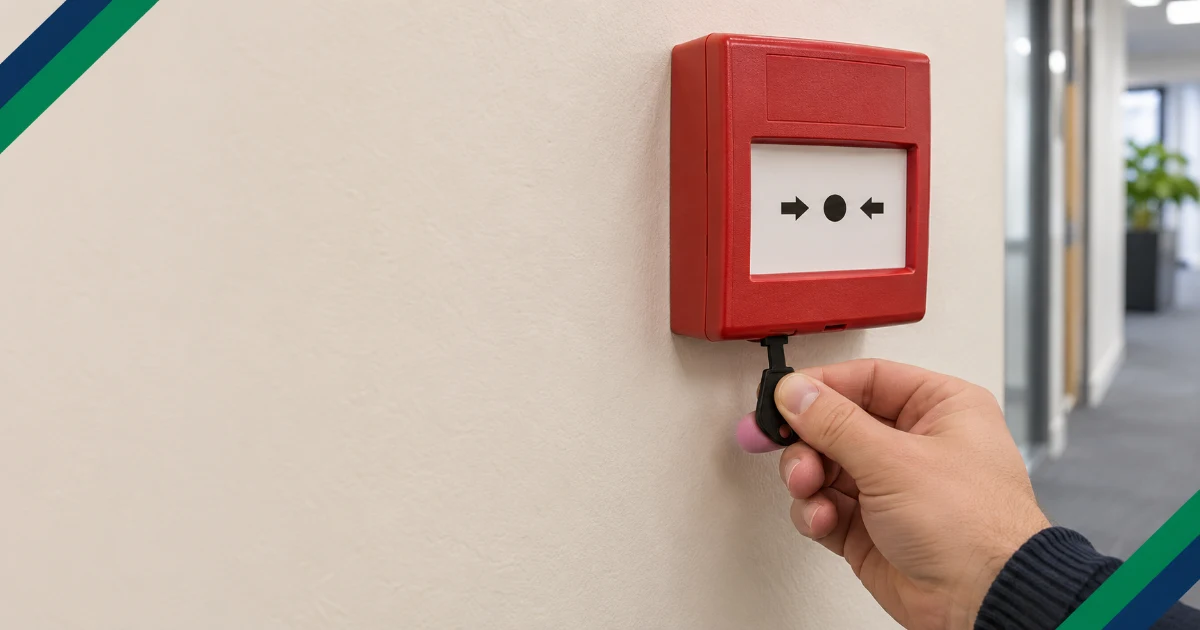
To carry out a weekly fire alarm test, activate one manual call point and check that the fire alarm panel receives the signal and the alarm sounds. GOV.UK says this is usually done with a test key, following the manufacturer’s or installer’s instructions.
Who should you notify before testing a monitored alarm?
Notify the alarm receiving centre before testing a monitored alarm. GOV.UK says arrangements should be made before testing a system connected to a central monitoring station, to avoid unwanted false alarms.
Which call point should you test each week?
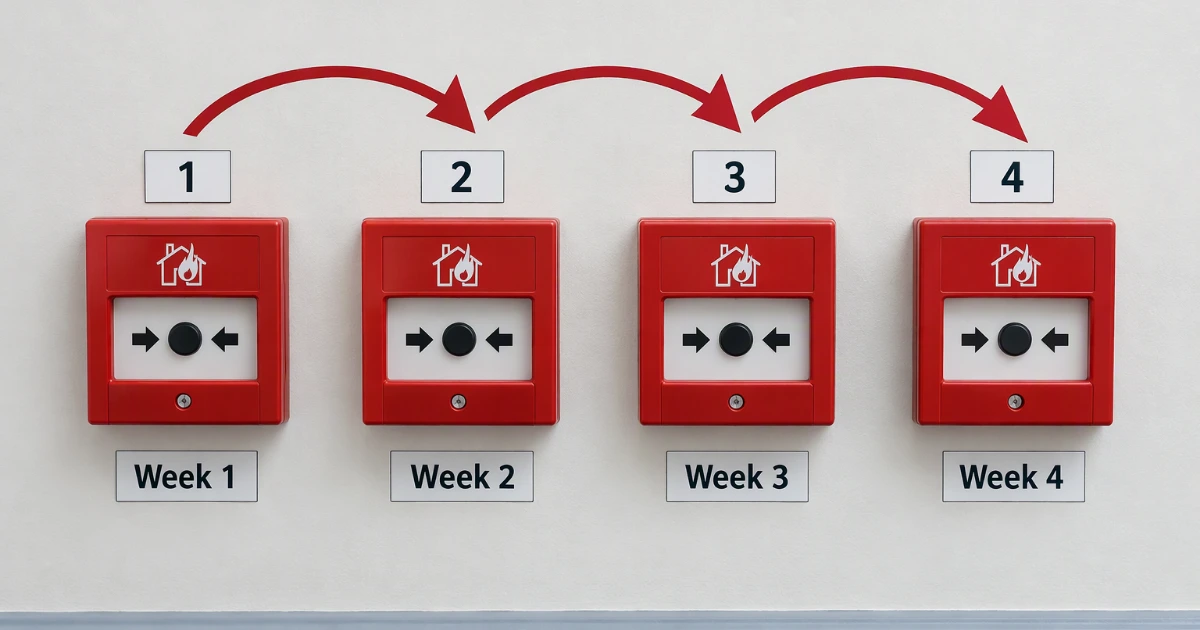
Test a different manual call point each week. GOV.UK says to use a different call point for each successive test, and manual call points may be numbered so they are tested in order.
Can you test the fire alarm outside normal working hours?
Yes, you can, and extra tests may be needed if people work outside normal hours. GOV.UK says it is good practice to test at the same time each week, but staff and others present outside normal working hours should have the chance to hear the alarm.
What should you record in a fire alarm testing log book?
Record every test, false alarm and any maintenance in a fire alarm testing log book. GOV.UK says this is good practice. The log should cover three things:
- Test results: whether testing a manual call point sent a signal to the panel and whether the alarm worked correctly, as the GOV.UK checklist asks.
- False alarms: every false alarm, so you can investigate the cause, as the Scottish Government advises.
- Maintenance: any servicing or repair work carried out on the system.
Records help you show the enforcing authority that you have complied with fire safety law. A log book or an electronic record is suitable, says the 2024 Home Office guide. In Scotland, the Scottish Government says to keep test and maintenance records for at least three years.
What happens during a professional fire alarm service?
During a professional fire alarm service, a competent person with specialist knowledge of fire warning and automatic detection systems carries out servicing and preventive maintenance, says GOV.UK. This is normally done under a service contract with a specialist fire alarm company, and the 2024 Home Office guide says the contractor inspects and tests the system at the six-monthly check. Keep the service record with your log book.
What should you do if a fire alarm test fails?
If a fire alarm test fails, record the fault and ask a competent person to repair it. Article 17 requires equipment to be kept in efficient working order and in good repair. GOV.UK says it is necessary in most cases to consult a competent service engineer about maintenance. The Scottish Government adds that a fire warning system should not be disabled, and that you should ask a competent contractor for advice if it causes a problem.
How often should fire alarms be tested at home?

Test smoke alarms at home at least monthly, says GOV.UK. Press the test button until the alarm sounds, which tests the smoke sensor as well as the power supply or battery. If it does not sound, you need to replace the battery.
The same GOV.UK guidance says to vacuum smoke alarms every six months to remove dust, and to make testing part of your regular household routine. Mains powered alarms need testing too, because they have a back-up battery in case of a power cut.
How often should alarms be tested in rented homes and HMOs?
In England, landlords check each alarm works on the day a new tenancy begins and keep a record, and tenants can test the alarms after that. Scotland, Wales and Northern Ireland set their own duties, and HMO managers have a separate legal duty to keep alarms working. Alarm checks sit alongside other landlord safety duties, and an EICR is a legal requirement for landlords in all four UK nations.
What must landlords do in England, Scotland, Wales and Northern Ireland?
Landlords must keep alarms in working order in every nation, and the details differ:
- England: landlords must check each alarm works on the day a new tenancy begins, keep a record, and repair or replace faulty alarms once told, says the GOV.UK landlord guidance.
- Scotland: homes need interlinked smoke and heat alarms, and the Scottish Government says they should be regularly maintained and tested to the manufacturer’s instructions.
- Wales: the Welsh Government requires a working smoke alarm on every storey, and landlords should note the alarm’s recommended life span.
- Northern Ireland: the Department for Communities says landlords should test alarms before a tenancy starts and advise tenants to test them once a week.
How does testing work for communal alarms in blocks of flats and HMOs?
HMO fire alarms are tested according to their system grade, and many blocks of flats have no communal alarm at all. For an HMO in England, the manager must keep fire alarms in good working order, says regulation 4 of the HMO Management Regulations 2006. The official guidance sets these testing routines:
- HMOs in England: the 2008 LACORS guidance says a Grade A system is tested weekly and serviced every six months, and Grade D smoke alarms are tested monthly with the test button.
- HMOs in Scotland: the Scottish Government guidance for premises with sleeping accommodation, which includes HMOs, gives a weekly manual call point test.
- HMOs in Northern Ireland: NIFRS says L1, L2 and Grade A systems are tested weekly and serviced every six months, and other grades monthly and serviced every 12 months.
- Blocks of flats: the Home Office guide says a general needs block will not normally need a communal alarm. Where one is fitted, it should have a weekly manual call point test and a service at least every six months.
How do fire alarm testing rules differ across the UK?
Fire alarm testing regulations in the UK differ most for rented homes. For workplaces, the official guidance in each nation gives the same weekly test and six-monthly service. The table compares each nation using the official sources above.
| Nation | Workplaces | Homes and rented homes |
|---|---|---|
| England | Article 17 maintenance duty. GOV.UK guidance: test weekly, service every six months | Test smoke alarms at least monthly. Landlords check alarms on the first day of a new tenancy |
| Wales | Article 17 maintenance duty. Welsh Government guidance: weekly test, six-monthly service | Working smoke alarm on every storey. Landlords note the alarm’s life span |
| Scotland | Regulation 16 maintenance duty. Scottish Government guidance: daily panel check, weekly test, six-monthly service | Interlinked alarms, tested to the manufacturer’s instructions |
| Northern Ireland | Regulation 16 maintenance duty. NIFRS guidance: weekly test, six-monthly service | Landlord tests before a tenancy. Tenants advised to test weekly |
For workplaces in every nation, the test interval is guidance rather than a fixed legal number, so your fire risk assessment decides the routine for your premises.
Alarm tests and servicing are a separate duty from reviewing the assessment itself. Our guide to when a fire risk assessment should be reviewed covers the triggers and what a review includes.
What is the difference between a fire alarm test and a fire drill?
A fire alarm test checks that the system works, while a fire drill checks that people know how to leave the building. GOV.UK says a workplace fire drill should be carried out at least annually, or as your fire risk assessment decides. The 2024 Home Office guide calls periodic drills a good way to test your fire procedures and staff understanding. If the alarm is monitored, tell the alarm receiving centre before the drill and again when it is finished.
How can I arrange a fire alarm test?
If you need a professional fire alarm test or service, send Checks Sorted one enquiry and we match it with a participating independent professional in your area, where we can. We do not test or service alarms ourselves. You can read more on our fire alarm servicing page. It takes four steps:
- Tell us the service
Choose fire alarm servicing from the list. - Give the postcode
Add the property postcode and a few details about the system. - We find a match
Checks Sorted looks for a participating professional for the service and the area. - Hear from the professional
They contact you about availability, price and what the work involves.
FAQs about how often fire alarms should be tested
How often should you check your fire alarm?
Check a workplace fire alarm panel at least every 24 hours and test the system once a week, says GOV.UK. At home, test smoke alarms at least monthly, says GOV.UK.
Is a six-monthly fire alarm service a legal requirement?
No, the law does not set a fixed interval. Article 17 in England and Wales requires a suitable system of maintenance, and Home Office guidance says a competent contractor should inspect and test the system at the six-monthly check. Your fire risk assessment decides the level of service.
Who tests the smoke alarms in a rented home?
In England the landlord checks the alarms on the first day of a new tenancy, and tenants can test them after that. The GOV.UK landlord guidance says testing does not need specialist skills, and landlords must repair or replace faulty alarms once they know.
How often should smoke alarm batteries be changed?
Smoke alarm batteries should be changed every year if the alarm has a one year battery, says GOV.UK. Replace the whole alarm every ten years if it is a ten year alarm. Replace a battery straight away if the alarm beeps on a regular basis.
Sources
- GOV.UK: Fire safety risk assessment, offices and shops
- GOV.UK: Small non-domestic premises fire safety guide
- GOV.UK: Fire safety in the home
- GOV.UK: Smoke and CO alarms, landlord guidance for England
- legislation.gov.uk: Fire Safety Order 2005, article 17
- legislation.gov.uk: Fire Safety (Scotland) Regulations 2006, regulation 16
- legislation.gov.uk: Fire Safety Regulations (Northern Ireland) 2010, regulation 16
- legislation.gov.uk: HMO Management Regulations 2006, regulation 4
- Welsh Government: Small non-domestic premises fire safety guide
- Scottish Government: Fire safety guidance, non-residential premises
- Scottish Government: Fire safety guidance, sleeping accommodation
- Scottish Government: Tolerable Standard fire detection guidance
- Welsh Government: Fitness of homes guidance for landlords
- Department for Communities: Private tenancy alarm regulations guidance
- NIFRS: Fire safety risk assessment, offices and shops
- NIFRS: HMO fire safety guide
- Fire Industry Association: Guide to the changes in BS 5839-1:2025
- LACORS: Housing fire safety guidance
- Home Office: Fire safety in purpose-built blocks of flats