
On this page
What is a gas safety check?How long does a gas safety check take for a typical home?Does the number of appliances change how long it takes?Is a gas safety check the same as a boiler service?What happens during a gas safety check?What can make a gas safety check take longer?How can you prepare for a gas safety check?Does the tenant need to be at home?When will you receive the gas safety record?Who needs a gas safety check?Do homeowners need a gas safety check?Who can carry out a gas safety check?When should you book the next check?Does a carbon monoxide alarm replace the check?Do the rules differ in Scotland, Wales and Northern Ireland?How can I arrange a gas safety check?FAQs about how long a gas safety check takesSources
Checks Sorted does not carry out gas safety checks or issue records itself. We match your enquiry with a participating independent professional, where we can.
Key facts
- Allow up to an hour. No regulator sets a time, and councils quote about 30 to 90 minutes for their own tenants’ homes.
- Every gas appliance and flue is checked, including portable gas heaters, says HSE’s guidance on what is checked.
- Only a Gas Safe registered engineer can do it, and a landlord cannot do it themselves.
- It is due every 12 months. You can book it up to 2 months early and keep the same deadline date.
- Tenants get a copy within 28 days of the check, or before a new tenant moves in.
- An unsafe appliance carries a “Danger Do Not Use” label and must not be used until it is put right.
- A tenant who refuses access does not let a landlord off. They must take all reasonable steps, but HSE says they must not use force.
What is a gas safety check?
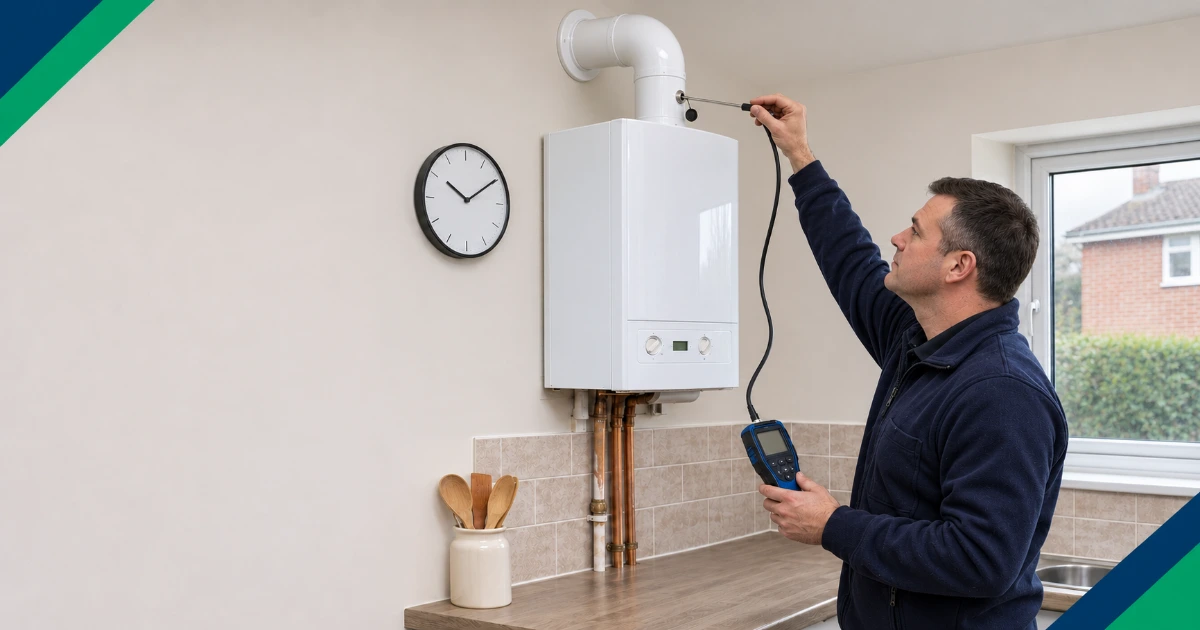
A gas safety check is a safety inspection of every gas appliance and flue in a rented home, which a landlord must have done at least every 12 months by a Gas Safe registered engineer. It is a legal duty under regulation 36 of the Gas Safety (Installation and Use) Regulations 1998, and HSE’s guidance on what is checked says it covers all permanent and portable gas appliances and flues in the property.
The engineer examines the flue, the air supply, the operating pressure or heat input and safe operation, then records the result on a Landlord’s Gas Safety Record, which HSE says was previously called a gas safety record, certificate or CP12 form. It is not the same as a boiler service.
How long does a gas safety check take for a typical home?
A gas safety check usually takes up to an hour for a typical home. No regulator gives a time for a gas safety check. We found none on the HSE, GOV.UK or legislation.gov.uk pages we read, so the only official figures come from councils, and they apply to council tenants’ homes. Four councils that publish a time quote between about 30 and 90 minutes, and three of the four quote an hour or less. These are estimates, not a legal rule, so a private visit can take more or less time.
The table shows what each council says:
| Council | Time quoted for its own tenants |
|---|---|
| South Lanarkshire Council | “Usually takes less than one hour” |
| Reading Borough Council | “Typically takes less than an hour” |
| Birmingham City Council | “About 45 minutes” |
| City of York Council | “Between 30 and 90 minutes”, depending on the condition and type of appliances |
Does the number of appliances change how long it takes?
More appliances can make a gas safety check take longer, but no official source says by how much. City of York Council says its gas safety checks “normally take between 30 and 90 minutes, depending on the condition and type of gas appliances you have”.
The check must cover every gas appliance and flue in the home, and HSE’s guidance on what is checked says that includes portable gas heaters. For each appliance, the engineer must examine the matters in regulation 26(9), such as the flue, the air supply and safe operation. A home with a boiler, a gas fire and a cooker therefore has more to examine than a flat with a single boiler. Because no regulator gives a figure for the extra time, ask the engineer for an estimate when you book.
Is a gas safety check the same as a boiler service?
No. A gas safety check is the legal inspection that gives landlords their yearly record, and a service is maintenance of the appliance. HSE guidance for landlords says “You should not assume that an annual service inspection meets the safety check requirement”, and that a check alone may not be enough to keep an appliance well maintained. HSE recommends an annual service where the manufacturer gives no instructions. No official source gives a time for a combined check and service visit, so ask the engineer how long both will take.
What happens during a gas safety check?
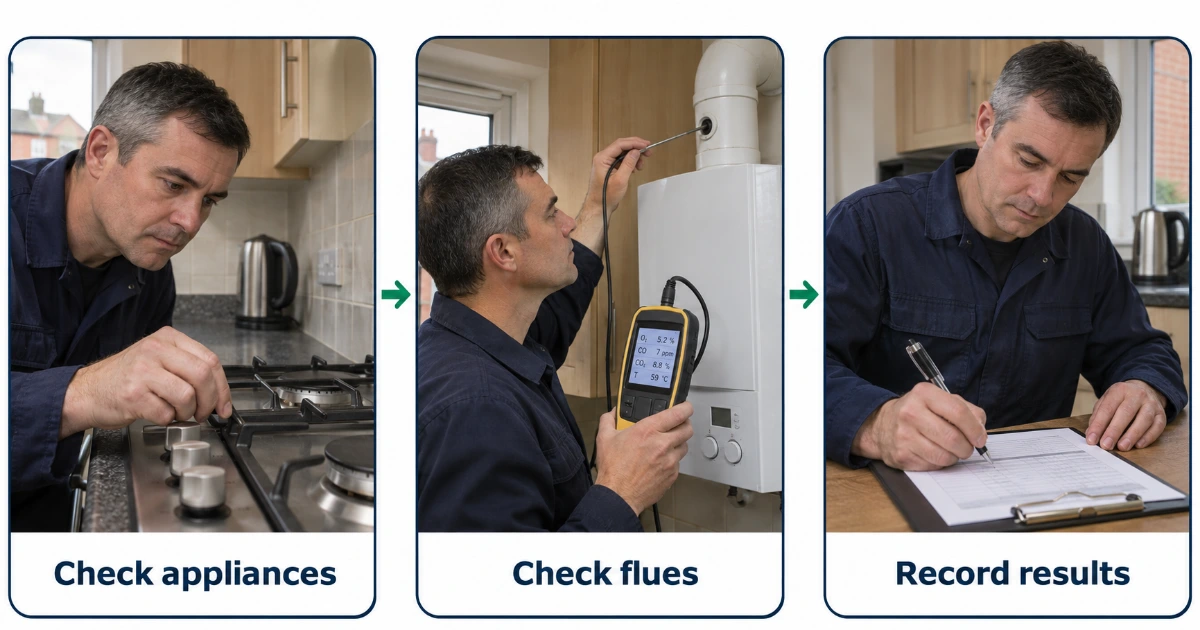
The engineer examines each gas appliance and its flue, then records the result. Regulation 36(9) of the Gas Safety (Installation and Use) Regulations 1998 says the check “shall include, but shall not be limited to” the matters in regulation 26(9). Our guide to what a gas safety check involves lists each item in full.
What does the engineer check?
Regulation 26(9) sets out four things the engineer must examine:
- The effectiveness of any flue.
- The supply of combustion air.
- The operating pressure or heat input, or the combustion performance where the pressure or heat input cannot reasonably be examined.
- The safe operation of the appliance.
South Lanarkshire Council describes its visit in everyday terms: appliances working properly and burning gas safely, enough ventilation, clear flues and chimneys, and working safety devices. Installation pipework is not part of the annual check, says HSE’s guidance on appliances and pipework, but HSE recommends asking your engineer to test the whole system for soundness and to examine the pipework visually.
Will your gas or heating be turned off?
No official statement says whether gas or heating is switched off during a routine check, so we cannot say either way. The official wording covers unsafe appliances. HSE’s gas safety FAQs says that if an engineer has switched an appliance off, it is because it is unsafe and should not be used, and a landlord must provide emergency heating if a heating appliance is disconnected.
What can make a gas safety check take longer?
No official source says how much time an access problem or a fault adds. Restricted access can stop the check being completed, and a fault means the appliance cannot be used until it is put right.
What if the engineer cannot get in?
A landlord must show they took all reasonable steps to get access, and HSE’s guidance on access to the property says they must not use force. HSE says the tenancy contract “should allow you access”, and “You must not use force to enter the property”. Under regulation 39, a landlord is not guilty of an offence if they can show they took all reasonable steps to prevent the breach.
HSE recommends these steps when a tenant does not give access, and says a record should be kept of all correspondence:
- Leave a notice saying you tried to visit, with your contact details.
- Write to the tenant to explain that the check is a legal requirement and is for their safety.
- Give the tenant the chance to arrange their own appointment.
HSE says inspectors “will look for repeated attempts”. No official page sets a minimum number of attempts, so do not rely on a fixed number.
What if the engineer finds a fault?
An appliance found to be “at risk” or “immediately dangerous” carries a “Danger Do Not Use” label and must not be used until it is put right, says HSE’s gas safety FAQs. HSE adds that “not to current standards” has been removed from the official procedure, although an engineer may still note it.
Landlords must take prompt action to correct any defect shown on the record, says HSE’s guidance on who needs a check. Regulation 34 also bars the responsible person for the premises from using, or allowing others to use, an appliance they suspect is dangerous.
How can you prepare for a gas safety check?
To prepare for a gas safety check, make sure the engineer can reach every gas appliance and the gas meter, and tell the tenant the date in advance. We found no official checklist, so this advice draws on council guidance and HSE’s advice to landlords.
What should you clear before the visit?
Give clear access to every gas appliance and to the gas meter, and make sure a prepayment meter has enough credit. South Lanarkshire Council says this helps keep the visit short. That is council advice to its own tenants, not a legal requirement.
What should landlords do before the visit?
Tell the tenant the date in writing and keep a copy. HSE strongly advises landlords to keep a record of all correspondence with tenants about access. If you use your own record form, HSE’s guidance on the gas safety record says you “must give it to the Gas Safe registered engineer to fill in before they do the gas safety check”. Also check that the engineer is registered for the type of appliance.
Does the tenant need to be at home?
We found no official rule that says the tenant or an adult must be at home. Bury Council tells its own tenants that, as part of their tenancy agreement, they must let the engineer in. In practice, someone usually needs to let the engineer in unless you have agreed another arrangement with your landlord.
When will you receive the gas safety record?
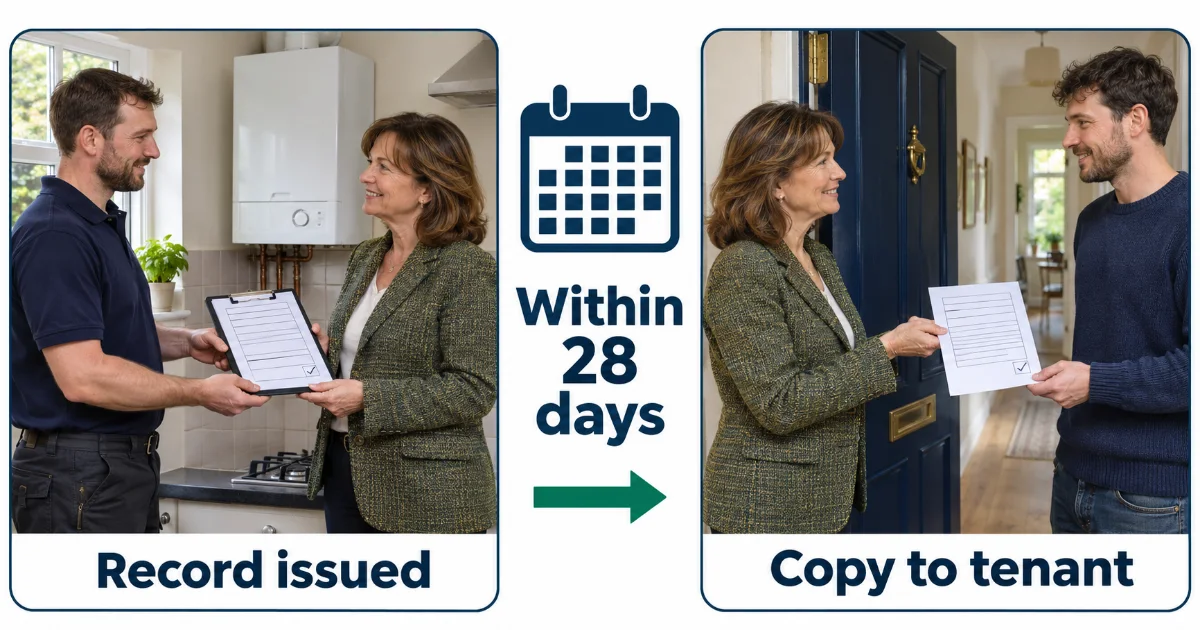
The engineer issues the Landlord’s Gas Safety Record once all the checks are complete, and the landlord must then give existing tenants a copy within 28 days of the check. HSE’s guidance on the gas safety record says the record “should be issued on completion of the checks” and not delayed because concerns are found. No official rule says it must be handed over the same day, and none sets a time limit for the engineer.
What does the gas safety record show?
A gas safety record must include these details, under regulation 36(3)(c):
- The date of the check and the address of the premises.
- The name and address of the landlord, or their agent.
- A description and the location of each appliance or flue checked.
- Any safety defect found and any action taken.
- Confirmation that the check covered the regulation 26(9) matters: the flue, the air supply, the pressure or heat input and safe operation.
- The engineer’s name, signature and registration number.
The landlord must keep the record until two further checks have been done. HSE’s guidance on the gas safety record gives a shorter version, “at least two years”.
When must landlords give tenants a copy?
Existing tenants must get a copy within 28 days of the date of the check, and a new tenant must get the latest record before they move in. That is regulation 36(6). HSE’s guidance on the gas safety record says a copy can be sent electronically if the tenant is happy with that and can open it, but a landlord “must give them a paper copy if they ask for it”.
Who needs a gas safety check?
Landlords must have a gas safety check done on each rented home that has gas appliances. HSE’s guidance for landlords says “A landlord is anyone who rents out a property they own under a lease or a licence that is shorter than seven years.” The duty covers council and housing association homes as well as private lets, because HSE lists local authorities and housing associations among those who need the checks.
HSE’s guidance on who needs a check gives these examples of people who take on the duty:
- A homeowner with a lodger who pays rent.
- An employer whose domestic staff live in the home.
- A hotel or bed and breakfast owner, for any appliance serving guest accommodation.
- The owner of rented holiday accommodation such as a chalet, cottage, flat, caravan or narrow boat.
Sub-letting does not pass the duty on, because HSE says the original landlord is still responsible. A family member who lives in the home rent free is not covered by the regulations, although HSE strongly recommends servicing the appliances.
Do homeowners need a gas safety check?
The annual gas safety check is a landlord duty, and HSE strongly advises homeowners to have a yearly service instead. Regulation 36 covers homes occupied for money or money’s worth under a lease or licence, and HSE does not say the check is a legal requirement for owner occupiers. HSE “strongly advises that all gas appliances, flues and pipework should be installed, regularly maintained and serviced at least annually by a Gas Safe registered engineer”. If you have shared ownership with a lease longer than 7 years, HSE says you have the same responsibilities as a homeowner. If you are selling, our guide to whether you need a gas safety certificate to sell a house explains what buyers can ask for.
Who can carry out a gas safety check?
Only a Gas Safe registered engineer can carry out a gas safety check. HSE’s guidance on who can do the check says “All checks must be done by a Gas Safe registered engineer”, and that a former gas fitter cannot do the check themselves. HSE advises you to check that the engineer is competent for the type of appliance, which is marked on the back of the registration card, or look them up on the Gas Safe Register website.
When should you book the next check?
Book the next gas safety check within 12 months of the last one, and you can do it up to 2 months early without losing any time. Regulation 36A(1) treats a check completed “within the period of 2 months ending with the deadline date” as made on the deadline date. For example, if the deadline is 10 June, a check done on 10 April still counts as made on 10 June.
HSE’s INDG285 leaflet puts this as a check done “10 to 12 calendar months after the previous check”, and says landlords are under no obligation to use it. A check done less than 10 months after the last one resets the clock to 12 months from the new check.
Does a carbon monoxide alarm replace the check?
No. HSE’s gas safety FAQs says alarms “should not be regarded as a replacement for regular maintenance and safety checks”. In England, landlords must also fit a carbon monoxide alarm in any room used as living accommodation that has a fixed combustion appliance, other than a gas cooker, under regulation 4 of the Smoke and Carbon Monoxide Alarm (England) Regulations 2015.
Electrical safety is a separate landlord duty, and you can check whether an EICR is a legal requirement in your nation.
Do the rules differ in Scotland, Wales and Northern Ireland?
The gas safety check rules are the same in England, Scotland and Wales, because they share the Gas Safety (Installation and Use) Regulations 1998. Northern Ireland has its own 2004 regulations, which also require an annual check and a copy to tenants within 28 days. The table compares them:
| Rule | England, Scotland and Wales | Northern Ireland |
|---|---|---|
| Regulations | Gas Safety (Installation and Use) Regulations 1998 | Gas Safety (Installation and Use) Regulations (Northern Ireland) 2004 |
| Annual check | At least every 12 months | At least every 12 months |
| Early check | Up to 2 months before the deadline date | No early check rule until 30 November 2026, then the same 2 month rule |
| Copy to tenants | Within 28 days, or before a new tenant moves in | Within 28 days, or before a new tenant moves in |
| Record kept | Until two further checks | Two years from the check, changing on 30 November 2026 to until two further checks |
The Northern Ireland amendment regulations of 2026 come into operation on 30 November 2026.
Scotland and Wales add guidance on access. The Scottish Government says tenants should get at least 48 hours’ notice, and the Rent Smart Wales tenant guide says 24 hours’ notice. Those notice periods are guidance, not part of the regulations. We found no official time for the check in any nation.
How can I arrange a gas safety check?
If your property needs a gas safety certificate, send Checks Sorted one enquiry and we match it with a participating independent professional in your area, where we can. We do not carry out checks ourselves. It takes four steps:
- Say what you need
Select the property safety service you want. - Add the postcode
Enter the property postcode and any other details. - Get matched
Checks Sorted finds a participating professional for the service and the location. - Talk it through
The professional contacts you about availability, price and the work required.
FAQs about how long a gas safety check takes
How long does a gas safety check take?
Allow up to an hour for a typical home. No regulator sets a time, and councils that publish one for their own tenants quote between about 30 and 90 minutes. A home with several appliances can take longer, but no official source says by how much.
Do you get the gas safety certificate on the day?
There is no official rule that says you must. HSE’s guidance on the gas safety record says the engineer should issue the Landlord’s Gas Safety Record on completion of the checks, and the landlord must then give existing tenants a copy within 28 days of the check.
Does a gas safety check include a boiler service?
No. HSE says you should not assume an annual service meets the safety check requirement, or that a safety check on its own provides effective maintenance. If you want both, ask the engineer how long the combined visit will take, because no official source gives one.
Do I need to be in for a gas safety check?
We found no official rule that says you must be. The engineer needs access to the appliances, so someone usually needs to let them in unless you have agreed another arrangement with your landlord.
What happens if the engineer finds a fault?
An appliance found to be “at risk” or “immediately dangerous” carries a “Danger Do Not Use” label, says HSE. The landlord must act promptly to put the defect right, and the appliance must not be used until it is.
What if my tenant will not let the engineer in?
A landlord must show they took all reasonable steps, and HSE says they must not use force. HSE recommends leaving a notice, writing to the tenant, offering them the chance to book their own appointment and keeping a record of all correspondence.
Is a gas safety check a legal requirement for homeowners?
The annual gas safety check is a landlord duty, and HSE does not say it is a legal requirement for homeowners. HSE strongly advises homeowners to have their gas appliances, flues and pipework serviced at least annually by a Gas Safe registered engineer.
Sources
- legislation.gov.uk: Gas Safety (Installation and Use) Regulations 1998, regulation 36
- legislation.gov.uk: Gas Safety (Installation and Use) Regulations 1998, regulation 36A
- legislation.gov.uk: Gas Safety (Installation and Use) Regulations 1998, regulation 26
- HSE: Gas safety checks, what is covered
- HSE: The landlord’s gas safety record
- HSE: Dealing with tenants, access to the property
- HSE: Landlords’ duties, Gas safety in rented property (INDG285)
- HSE: Gas safety frequently asked questions
- legislation.gov.uk: Gas Safety (Installation and Use) Regulations (Northern Ireland) 2004
- legislation.gov.uk: Gas Safety (Installation and Use) (Amendment) Regulations (Northern Ireland) 2026
- Scottish Government: Repairing standard statutory guidance, gas safety