
On this page
What is a gas safety check?What does the engineer check during a gas safety inspection?Which gas appliances need checking?Who is responsible for tenant-owned appliances and shared boilers?What does a gas safety check not include?Is the installation pipework checked?Are repairs included in the appointment?Does a gas safety check include radiators?Is a boiler service part of a gas safety check?What should you confirm when you book?How do you check the engineer’s Gas Safe ID card?What happens if the engineer finds a safety problem?When might the engineer turn off or disconnect an appliance?Who arranges repairs and follow-up checks?What should you do if you smell gas?What paperwork should you receive after the check?Will you receive a record if the engineer finds a fault?How long does a gas safety check take and how can you prepare?Do the rules differ in Scotland, Wales and Northern Ireland?How can I arrange a gas safety check?FAQs about what a gas safety check involvesSources
Checks Sorted does not carry out gas safety checks or issue records itself. We match your enquiry with a participating independent professional, where we can.
Key facts
- Four legal matters. The regulations name the flue, the combustion air supply, the operating pressure or heat input and safe operation.
- Every appliance and flue the landlord provides is covered, including portable gas heaters, says HSE’s guidance on what is checked.
- Not included: installation pipework, says HSE, and a boiler service is a separate job.
- Tenant’s own appliances are the tenant’s responsibility, although HSE recommends the landlord includes all flues.
- Only a Gas Safe registered engineer can carry out the check.
- An unsafe appliance carries a “Danger Do Not Use” label and must not be used until it is put right.
- The record must reach existing tenants within 28 days of the check.
What is a gas safety check?
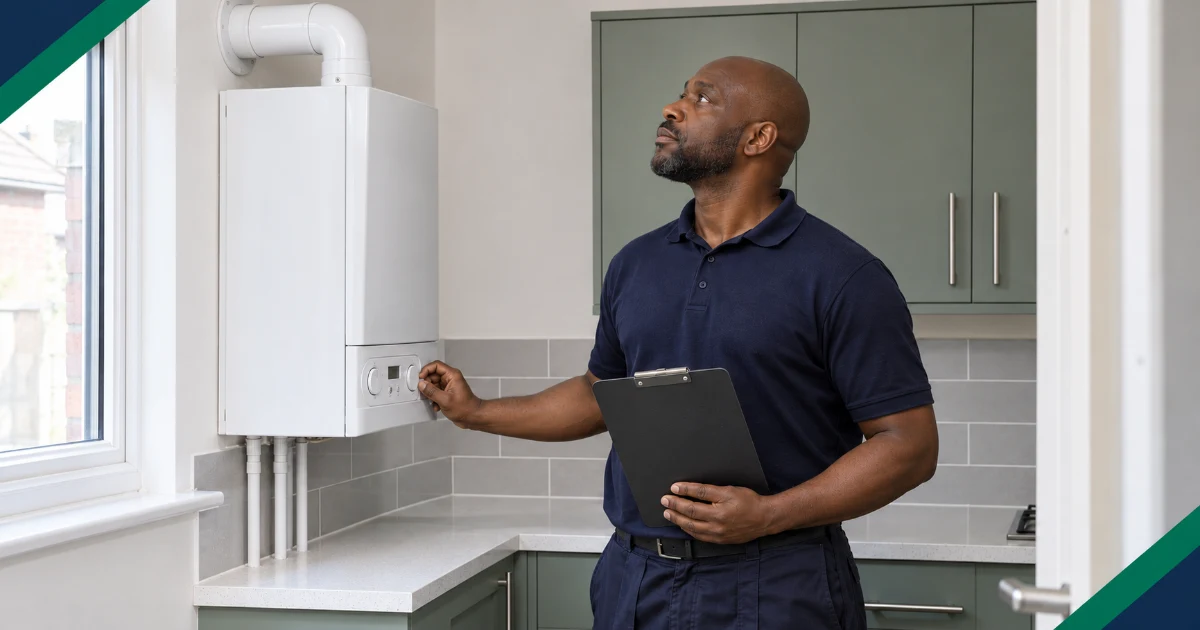
A gas safety check is a safety inspection of each gas appliance and flue in a rented home, which a landlord must have done at least every 12 months by a Gas Safe registered engineer. It is a legal duty under regulation 36 of the Gas Safety (Installation and Use) Regulations 1998, and the engineer records the result on a Landlord’s Gas Safety Record.
The engineer must be on the Gas Safe Register, the register HSE names for this work. HSE’s guidance on the gas safety record says it was previously called a gas safety record, certificate or CP12 form. The duty applies to anyone who rents out a property under a lease or licence shorter than seven years, including council and housing association landlords. Owners who are selling should read our guide to whether you need a gas safety certificate to sell a house.
What does the engineer check during a gas safety inspection?
The engineer must examine four things: the flue, the supply of combustion air, the operating pressure or heat input, and the safe operation of the appliance. Regulation 36(9) says the check “shall include, but shall not be limited to” the matters in regulation 26(9), so the check can go further than these matters but not cover less. The regulation lists them as:
- The effectiveness of any flue.
- The supply of combustion air.
- The operating pressure or heat input, or the combustion performance where the pressure or heat input cannot reasonably be examined.
- The appliance’s operation, so as to ensure its safe functioning.
HSE guidance L56 gives more detail for engineers. That guidance is not the legal minimum, so we label it as guidance below.
Are flues and ventilation checked?
Yes. The flue and the air supply are two of the four legal matters. HSE’s gas safety FAQs explain why: appliances need “an adequate supply of air to help the complete combustion of gas” and “efficient operation of their flue to remove any combustion products, including carbon monoxide (CO)”.
HSE guidance for engineers in L56 describes a flue flow test to check the flue is effective and does not leak, followed by a spillage test to check that combustion products are being safely removed.
Are operating pressure or heat input checked?
Yes. The engineer examines the operating pressure or heat input, or the combustion performance where the pressure or heat input cannot reasonably be examined. Regulation 26(9)(c) covers the operating pressure or heat input, and 26(9)(ca) covers the combustion performance. HSE’s L56 guidance says the combustion performance applies where there is no meter or meter display to measure the heat input and the operating pressure cannot be measured.
Is safe operation checked?
Yes. The fourth matter the engineer must examine is the appliance’s operation “so as to ensure its safe functioning”. HSE’s L56 guidance for engineers adds that the appliance and its gas fittings and safety devices, such as flame protection and fan proving systems, should function safely. We found no official page that explains how an engineer carries out each test, only what must be examined.
Which gas appliances need checking?
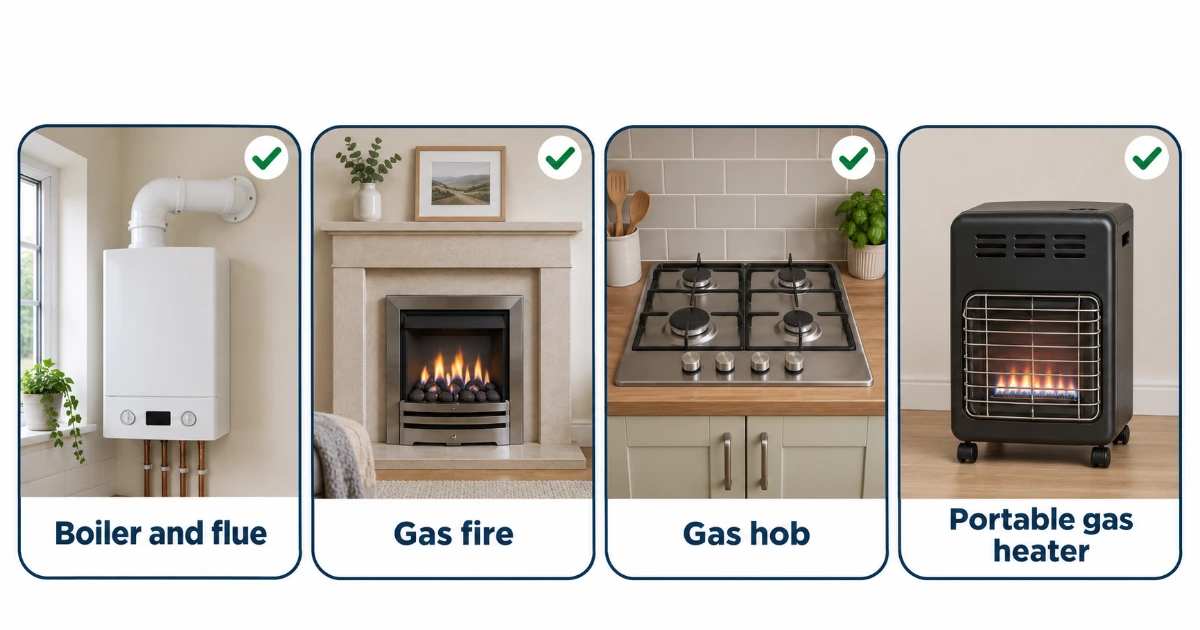
Every gas appliance and flue the landlord provides for the tenants needs an annual gas safety check. HSE’s guidance on what is checked says “All permanent and portable gas appliances and flues in the property require an annual gas safety check.” The regulations define a gas appliance as one designed for “heating, lighting, cooking or other purposes”, so a gas cooker the landlord provides counts as well as a boiler or gas fire.
Which landlord-provided appliances are included?
Every gas appliance the landlord provides is included. HSE’s guidance on what is checked says “Any gas appliance that you own and provide for the tenant’s use is included in your legal duties”. Portable heaters count too. HSE says a mobile space heater such as an LPG heater needs a check, and the regulations bring a portable or mobile space heater supplied with gas from a cylinder into the landlord duty. HSE guidance in L56 says appliances using non-refillable gas containers, such as some camping stoves, are not covered.
If a previous tenant left an appliance, HSE’s guidance on what is checked says you should either remove it or arrange for a Gas Safe registered engineer to check it.
What if there are no gas appliances?
If the property has no gas appliances, no annual gas safety check is needed. HSE says “As there are no gas appliances, there is no requirement for an annual gas safety check.” Its example is a home where pipework or a flue passes through but nothing runs on gas. The landlord must still maintain the pipework in a safe condition and carry out any required repairs.
Who is responsible for tenant-owned appliances and shared boilers?
The tenant is responsible for their own appliance and for the flue if it serves only that appliance, says HSE’s guidance on what is checked. HSE still recommends that the landlord includes all flues, such as chimneys, in the check, even where they do not serve appliances the landlord provides.
A communal boiler is different. HSE’s guidance on what is checked says the landlord must ensure it is “checked as part of the annual gas safety check”, which may mean working with the building owner.
What does a gas safety check not include?
A gas safety check does not include installation pipework, as HSE’s guidance on appliances and pipework explains, and it is not a boiler service. The legal check covers gas appliances and flues. We found no official page that lists radiators or repairs as part of it, so ask the engineer about both when you book.
Is the installation pipework checked?
No. HSE’s guidance on appliances and pipework says “Installation pipework is not covered by the annual gas safety check.” It recommends asking the engineer when you book to test “for soundness on the whole gas system, including installation pipework” and to examine the pipework visually “as far as is reasonably practicable”.
The landlord has a separate duty under regulation 36(2) to keep installation pipework in a safe condition.
Are repairs included in the appointment?
Not as a standard part of the check. We found no official page that says repairs are part of the check appointment. The record must show “any safety defect identified” and “any remedial action taken”, and HSE’s guidance on who needs a check says landlords must take prompt action on any defect “if it wasn’t rectified at the time of the safety check”. A repair may therefore happen at the visit or later, so ask the engineer when you book.
Does a gas safety check include radiators?
No, radiators are not one of the four legal matters. We found no official page that says radiators are part of a gas safety check. Regulation 26(9) asks the engineer to examine the flue, the combustion air, the pressure or heat input and safe operation, and radiators are not on that list.
Some councils add more to their own visits. Crawley Borough Council says its check for council tenants includes a visual inspection of radiators, cold water storage tanks and cylinders. That is the council’s own service, not the legal check. If you want the wider heating system looked at, ask the engineer before the visit.
Is a boiler service part of a gas safety check?
No. A boiler service is not part of a gas safety check. HSE guidance for landlords says “You should not assume that an annual service inspection meets the safety check requirement”, and that a check alone may not be enough to keep an appliance well maintained. The table shows the difference:
| Question | Gas safety check | Boiler service |
|---|---|---|
| Is it a legal duty for landlords? | Yes, at least every 12 months | HSE’s guidance on appliances and pipework recommends it, to the manufacturer’s instructions or annually if there are none |
| What do you get? | A Landlord’s Gas Safety Record, with a copy to tenants | HSE says there are no formal requirements to keep maintenance records |
| Who must do it? | A Gas Safe registered engineer | HSE says maintenance checks and repairs must be done by a Gas Safe registered engineer |
What should you confirm when you book?
Confirm that the engineer is Gas Safe registered and that the visit covers every appliance and flue. HSE’s guidance on who can do the check says “All checks must be done by a Gas Safe registered engineer”, and that a former gas fitter cannot do the check themselves. Regulation 36(4) refers to a class of persons approved by HSE, and HSE names Gas Safe Register.
Before the visit, make sure you know:
- Which appliances and flues are included, including any tenant-owned or communal ones.
- Whether you want the pipework soundness test that HSE recommends as an extra.
- Whether you also want a service, which is a separate job.
- How and when you will receive the record.
How do you check the engineer’s Gas Safe ID card?
Look at the back of the card, which shows the gas work the engineer is competent to do. HSE’s guidance on who can do the check advises you to check that it matches the appliance. You can also use the Check an Engineer service on the Gas Safe Register website, where HSE says entering the licence number from the ID card shows the engineer’s picture and qualifications.
What happens if the engineer finds a safety problem?
The appliance must not be used until it is put right, and the landlord must act promptly. An appliance found to be “at risk” or “immediately dangerous” carries a “Danger Do Not Use” label, say HSE’s gas safety FAQs. The FAQs add that “not to current standards” has been removed from the official procedure, although an engineer may still note it.
When might the engineer turn off or disconnect an appliance?
An engineer switches off or disconnects an appliance when it is unsafe. HSE’s landlord FAQs say an appliance switched off by a Gas Safe registered engineer “is unsafe and should not be used”, and that a landlord must provide emergency heating if a heating appliance is disconnected.
HSE guidance in L56 says the engineer should try to persuade the user or owner to allow a repair or disconnection but “has no legal power to take such action if the user/owner disagrees”. In that case the appliance should be labelled as unsafe, and the person responsible must not use it.
Who arranges repairs and follow-up checks?
The landlord arranges repairs and any follow-up checks. HSE’s guidance on the gas safety record calls the record a “living document” that landlords should supplement with “records of any follow up action taken”. Any safety defect must be put right by a Gas Safe registered engineer before the equipment is used again.
What should you do if you smell gas?
Act at once and call the Gas Emergency Freephone number on 0800 111 999. HSE’s gas safety FAQs say that if you suspect there is a gas leak you should do the following:
- Call the Gas Emergency Freephone number on 0800 111 999.
- Open all the doors and windows.
- Shut off the gas supply at the meter control valve, if you know where it is.
The same FAQs give similar advice for carbon monoxide (CO). If you think an appliance is spilling CO, call the same number, switch off the appliance and shut off the gas supply at the meter control valve. HSE also says CO alarms “should not be regarded as a replacement for regular maintenance and safety checks”.

What paperwork should you receive after the check?
The engineer issues a Landlord’s Gas Safety Record once all the checks are complete. It covers every appliance and flue in one document, because HSE’s guidance on the gas safety record says “usually one record is issued providing details of all the items checked”.
What does the landlord gas safety record include?
The record must contain at least these details, says HSE’s guidance on the gas safety record:
- A description and the location of each appliance or flue checked.
- The engineer’s name, registration number and signature.
- The date of the check and the address of the property.
- The name and address of the landlord, or their agent.
- Any safety-related defect and any remedial action taken.
- Confirmation that the check included the regulation 26(9) matters.
Regulation 36(3)(c) sets these out in full, and the landlord must keep the record until two further checks have been done.
When must landlords give tenants a copy?
Existing tenants must get a copy within 28 days of the date of the check, and a new tenant must get the latest record before they move in. That is regulation 36(6). HSE says a landlord “must give them a paper copy if they ask for it”.
Will you receive a record if the engineer finds a fault?
Yes, you should still receive the record if the engineer finds a fault. HSE’s guidance on the gas safety record says the record “should be issued on completion of the checks and not delayed even if concerns are found”. HSE guidance in L56 adds that it should not be issued “unless and until all the required tests/examinations have been completed on all relevant appliances and flues”. Together they mean you get the record once every test is finished, without waiting for repairs.
How long does a gas safety check take and how can you prepare?
No regulator sets a time, and councils that publish one quote between about 30 and 90 minutes for their own homes, as we explain in how long a gas safety check takes. To prepare, make sure the engineer can reach every appliance and flue and tell the tenant the date in advance. We found no official preparation checklist, so this is practical advice.
Do the rules differ in Scotland, Wales and Northern Ireland?
Not in what the engineer examines. The same check applies across England, Scotland and Wales, because the 1998 Regulations extend to all three. Northern Ireland has its own 2004 regulations with the same core duties. The amending regulations of 2026 come into operation on 30 November 2026 and add the two month early check and the keep until two further checks rule that England, Scotland and Wales have had since 2018. Those changes affect timing and record keeping, not what the engineer examines.
How can I arrange a gas safety check?
If your property needs a gas safety certificate, send Checks Sorted one enquiry and we match it with a participating independent professional in your area, where we can. We do not carry out checks ourselves. It takes four steps:
- Say what you need
Select the property safety service you want. - Add the postcode
Enter the property postcode and any other details. - Get matched
Checks Sorted finds a participating professional for the service and the location. - Talk it through
The professional contacts you about availability, price and the work required.
FAQs about what a gas safety check involves
What does a gas safety check involve?
The engineer examines every gas appliance and flue the landlord provides for four things: the flue, the combustion air supply, the operating pressure or heat input, and safe operation. They then issue a Landlord’s Gas Safety Record. The check does not cover installation pipework or include a boiler service.
Do they check radiators in a gas safety check?
No, radiators are not one of the four legal matters. We found no official page that says radiators are part of a gas safety check, and radiators are not among the four matters in regulation 26(9). Some councils include a visual look at radiators in their own visits, so ask the engineer if you want the wider heating system looked at.
Is the pipework checked in a gas safety check?
No. HSE’s guidance on appliances and pipework says installation pipework is not covered by the annual check. It recommends asking the engineer to test the whole gas system for soundness and to examine the pipework visually. The landlord must still keep pipework in a safe condition.
Does a boiler service count as a gas safety check?
No. HSE guidance for landlords says you should not assume that an annual service inspection meets the safety check requirement, so a boiler service does not replace the check or its record, which many people call the gas safety certificate. A service is maintenance, and HSE recommends one to the manufacturer’s instructions or annually if there are none.
Are tenant-owned appliances checked?
No, the landlord’s check does not cover a tenant’s own appliances. HSE’s guidance on what is checked says tenants are responsible for checking their own appliances and the flue if it serves only their appliance. HSE recommends that the landlord still includes all flues, such as chimneys, in the check.
What happens if the engineer finds a fault?
The appliance must not be used until a Gas Safe registered engineer has put it right, and the landlord must act promptly. An appliance found to be “at risk” or “immediately dangerous” carries a “Danger Do Not Use” label, say HSE’s gas safety FAQs.
Do you still get a record if there is a fault?
Yes. HSE’s guidance on the gas safety record says the record should be issued on completion of the checks and not delayed because concerns are found or because repairs have not been done.
Who can carry out a gas safety check?
Only a Gas Safe registered engineer can carry out a gas safety check. HSE’s guidance on who can do the check says “All checks must be done by a Gas Safe registered engineer”, and advises you to check that the engineer is competent for the type of appliance, which is marked on the back of their ID card.
Sources
- legislation.gov.uk: Gas Safety (Installation and Use) Regulations 1998, regulation 26
- legislation.gov.uk: Gas Safety (Installation and Use) Regulations 1998, regulation 36
- HSE: L56, Safety in the installation and use of gas systems and appliances
- HSE: Landlords’ duties, Gas safety in rented property (INDG285)
- HSE: Gas safety checks, what is covered
- HSE: Gas appliances, maintenance and pipework
- HSE: The landlord’s gas safety record
- HSE: Gas safety checks, who can carry them out
- HSE: Gas safety frequently asked questions
- legislation.gov.uk: Gas Safety (Installation and Use) Regulations (Northern Ireland) 2004
- legislation.gov.uk: Gas Safety (Installation and Use) (Amendment) Regulations (Northern Ireland) 2026