
On this page
What does EICR stand for?What is the purpose of an EICR?What does an EICR involve?Is an EICR an electrical safety certificate?What is the difference between an EICR and an EIC?Who needs an EICR?How often is an EICR required?What do the C1, C2, C3 and FI codes mean?What happens if an EICR is unsatisfactory?How can I arrange an EICR?FAQs about EICR meaning
ChecksSorted does not carry out inspections or issue certificates itself. We match your enquiry with a participating independent professional, where we can.
What does EICR stand for?
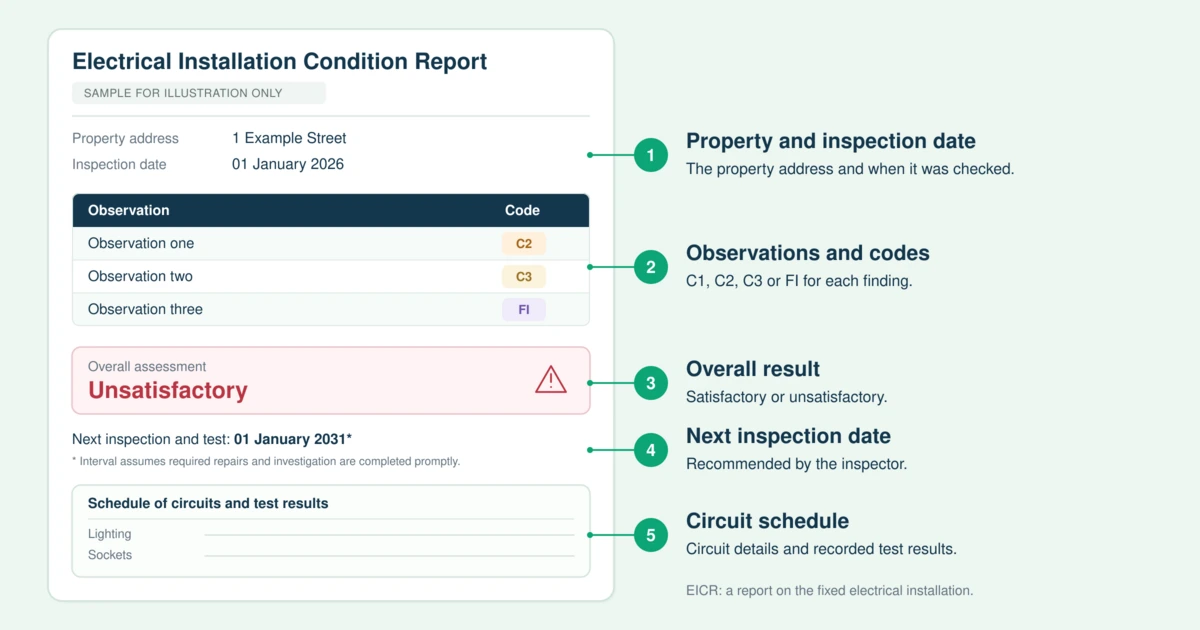
EICR stands for Electrical Installation Condition Report. The electrical installation is the fixed wiring and equipment built into a building, and the report records its condition rather than repairing anything. Electrical Safety First describes the report as detailing any observed damage, deterioration, defects, dangerous conditions and any non-compliances with the present-day safety standard that might give rise to danger.
The electrician checks the installation against BS 7671, the UK standard for electrical installations, also known as the IET Wiring Regulations. You may also hear it called periodic inspection and testing, or fixed wire testing, according to NICEIC. The EICR meaning is the same across the UK, but the rules on who needs one differ by nation.
What is the purpose of an EICR?
The purpose of an EICR is to find out whether the electrics are in a satisfactory condition for continued use. Electrical Safety First says the checks reveal if any circuits or equipment are overloaded, find potential electric shock risks and fire hazards, identify defective electrical work, and highlight any lack of earthing or bonding. It adds that all electrical installations deteriorate with age and use, which is why the checks are repeated.
What does an EICR involve?
An EICR involves an electrician inspecting and testing the fixed electrical installation and recording what they find. Electrical Safety First lists what the inspection checks:
- the adequacy of earthing and bonding
- the suitability of the switchgear and controlgear
- the serviceability of switches, sockets and lighting fittings
- the type and condition of the wiring system
- the protection of sockets that may supply outdoor equipment by a residual current device
- the presence of adequate identification and notices
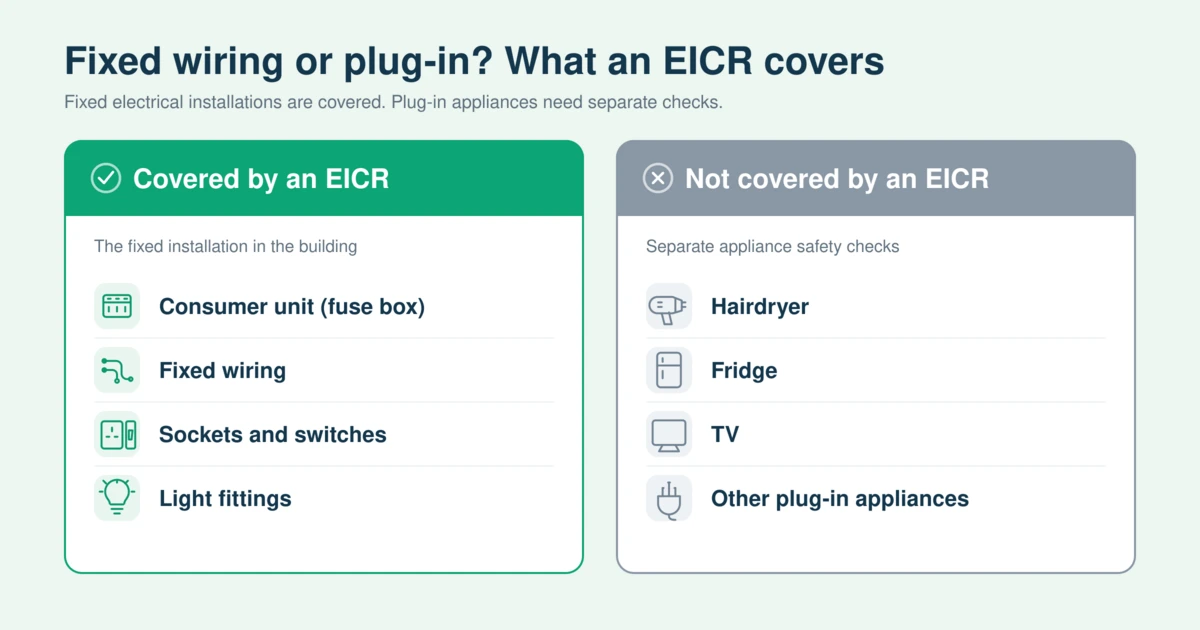
The Scottish Government guidance lists the consumer unit, light fittings, light switches, socket outlets and any visible wiring. The electrician then states whether the installation is satisfactory for continued use. Portable appliances are not part of it: the Scottish guidance treats testing of electrical equipment, also known as PAT testing, as a separate check. NICEIC says the electrician also tests the circuits, including continuity, insulation resistance, polarity, earth fault loop impedance and RCD operation.
Is an EICR an electrical safety certificate?
Many people call it one, but an EICR is a report, not a certificate. GOV.UK describes it as a report from the person who inspected and tested the installation, explaining the outcome and any investigative or remedial work required.
People who search for the EICR certificate meaning are usually asking about this same report: a record of how the wiring stood on the day, with an overall result of satisfactory or unsatisfactory.
What is the difference between an EICR and an EIC?
An EICR reports on the condition of an existing installation, while an Electrical Installation Certificate (EIC) is for new work. According to GOV.UK, premises that are newly built or have been completely rewired should have an EIC. The two differ as follows:
| EICR | EIC | |
|---|---|---|
| Full name | Electrical Installation Condition Report | Electrical Installation Certificate |
| What it is for | Reporting on the condition of an existing installation | New work, such as a newly built home or a complete rewire |
| What it gives a landlord in England | The result, and the date of the next inspection and test | No further checks or report needed for 5 years after it is issued, if the landlord has met their duties |
So the EICR meaning is about the condition of wiring that already exists, and the EIC is the paperwork for new work. GOV.UK also lists a Minor Electrical Installation Works Certificate among the acceptable written confirmations. Our electrical installation certificate guide explains the EIC in full.
Who needs an EICR?
Private landlords in England, Scotland, Wales and Northern Ireland need one, each under their own rules, and social landlords in England now do too. If you own and live in the home, the landlord rules do not apply, although Electrical Safety First advises an inspection about every 10 years.
It depends on the situation:
| Situation | Is an EICR needed? | Official source |
|---|---|---|
| Private rented home, England | Yes, inspected and tested at least every 5 years | GOV.UK |
| Social rented home, England | Yes, the 2020 regulations were extended to social landlords in 2025 | GOV.UK |
| Private rented home, Scotland | Landlords should ensure an EICR is completed every 5 years under the Repairing Standard | Scottish Government |
| Rented home, Wales | Yes, tested every 5 years unless the last report sets a shorter interval | Welsh Government |
| Private rented home, Northern Ireland | Yes, inspected and tested at least every 5 years | Department for Communities |
| A home you own and live in | Not a landlord duty; the advice is every 10 years | Electrical Safety First |
| Buying or selling a home | Advised before selling, or before buying a previously occupied property | Electrical Safety First |
| Business premises | The regulation sets no EICR interval; systems must be maintained to prevent danger | Electricity at Work Regulations 1989, regulation 4 |
The landlord electrical safety certificate guide sets out the full landlord duties. GOV.UK also lists tenancies that are excluded from the England rules, such as long leases, student halls of residence and hostels.
How often is an EICR required?
A rented home needs one at least every 5 years, and sooner if the report says so. GOV.UK says the report gives the results and sets a date for the next inspection and test. For a home you own and live in, Electrical Safety First advises every 10 years. Our guide on how long an EICR lasts covers the timing in full.
The Northern Ireland interval is the same, at least every 5 years, or more often if the qualified person doing the inspection thinks it is necessary, says the Department for Communities.
What do the C1, C2, C3 and FI codes mean?
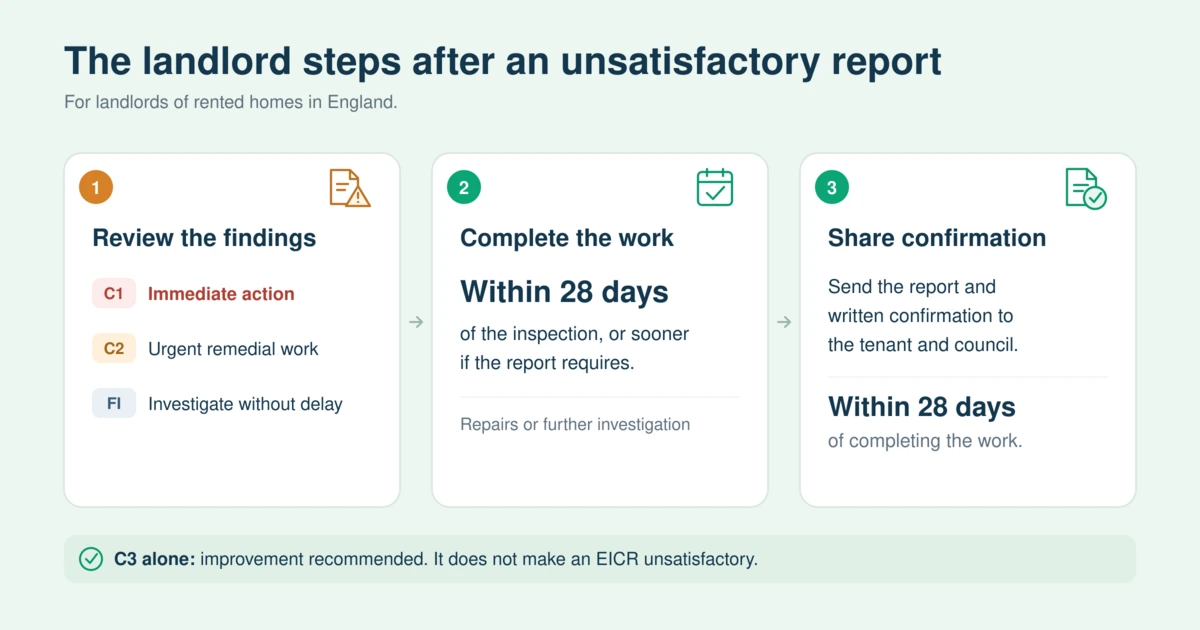
C1 means danger present, C2 potentially dangerous, C3 improvement recommended and FI further investigation required without delay, according to GOV.UK. The table adds what each means for remedial work:
| Code | What it means | Is remedial work needed? |
|---|---|---|
| C1 | Danger present. Risk of injury. | Yes, and the report is unsatisfactory |
| C2 | Potentially dangerous. | Yes, and the report is unsatisfactory |
| C3 | Improvement recommended. | No, the report can still be satisfactory |
| FI | Further investigation required without delay. | The landlord must ensure the investigation is carried out |
Our guide to the C1, C2, C3 and FI codes explains them with examples.
What happens if an EICR is unsatisfactory?
An unsatisfactory EICR means the installation is not safe for continued use until the problems are put right. GOV.UK says that if code C1 or C2 is identified, remedial work is required and the report states the installation is unsatisfactory for continued use. In England the landlord must complete the remedial or further investigative work within 28 days, or any shorter period the report specifies. Within 28 days of finishing, they must give the tenant and the local council the report and written confirmation from the person who did the work.
The inspector may make any C1 hazards safe before leaving the premises. A C3 on its own does not require remedial work. The Department for Communities sets the same 28 days in Northern Ireland. See our guide to EICR remedial works for the next steps.
How can I arrange an EICR?
To arrange an EICR, send one enquiry and ChecksSorted matches it with a participating independent professional covering the service and your area, where we can. We do not visit or test properties ourselves. An EICR enquiry goes through four steps:
- Tell us what you need
Choose the property safety service required. - Tell us where
Enter the property postcode and relevant details. - We match your enquiry
ChecksSorted identifies an appropriate participating professional covering the service and location. - Discuss the job
The professional contacts you about availability, price and the work required.
You can also read how EICR quotes work on our EICR page.
FAQs about EICR meaning
Is an EICR a legal requirement?
Yes for landlords, under the rules of each nation. Electrical Safety First says the inspection is a legal requirement across the whole of the UK for privately rented homes, and the table above shows each nation. For a home you own and live in, it is advice rather than a landlord duty.
How much does an EICR cost in the UK?
The price depends on the property and the work involved, so it comes from the professional who quotes. ChecksSorted does not set prices. Our EICR cost guide explains what affects the price and what to ask in a quote.
Is an EICR the same as PAT testing?
No, an EICR covers the fixed installation, such as the consumer unit, wiring, sockets and switches, while PAT testing checks portable electrical appliances. The Scottish Government guidance lists the two as separate parts of an electrical safety inspection, on its Repairing Standard page.
What fails an EICR?
Nothing passes or fails: because the EICR meaning is a report on condition, the overall result is satisfactory or unsatisfactory. A C1 or C2 makes the report unsatisfactory for continued use, according to GOV.UK, while a C3 on its own does not require remedial work. The codes are in the table above.
Who can carry out an EICR?
It should be someone competent to inspect and test, such as a registered electrician. GOV.UK calls this a qualified person, and Electrical Safety First says periodic inspection should be carried out only by electrically competent persons. Its find a registered electrician tool is one place to look.